Helping design and engineering professionals discover, evaluate and specify technologies and processes that shorten the design cycle and enable success.


Alert!
Digital Engineering ceased publication on July 1, 2026. This website remains available as an archive of engineering content.
For inquiries or information, please email [email protected].

Digital Engineering April 2026
In the latest issue of Digital Engineering, we take a look at the latest innovations in design for additive manufacturing, including the use of natural language inputs, social media cosplayers, and AI integration. The issue also includes a feature…

January Special Focus Issue: Design for Additive
In this Special Focus Issue of Digital Engineering, learn about the latest advancements in design for additive manufacturing, including new software tools, additive in automotive, custom medical devices, and more.
The additive manufacturing (AM) industry has had a rough few years, with many hardware providers struggling, but interest in the technology continues to increase as manufacturers look for ways to generate innovative products and onshore some production capabilities.
At the RAPID+TCT 2025 event in Detroit, more than 500 leading companies in the additive manufacturing space gathered with 10,000 attendees to show off the latest developments in 3D printing hardware and software.
During the opening executive panel, moderated by Todd Grimm of T.A. Grimm & Associates and AMUG, representatives from a number of leading 3D printing companies outlined how the industry has shifted in response to challenging market conditions over the past few years.
The panel featured Materialise CEO Brigitte de Vet-Veithen; Formlabs Chief Revenue Officer Nick Graham; Stratasys CEO Yoav Zeif; and EOS President Glynn Fletcher.
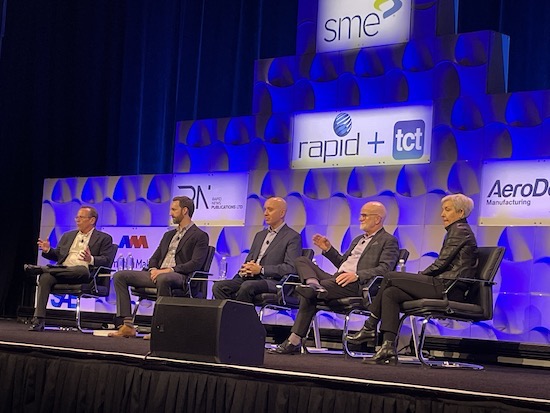
“There are no ups without downs,” Fletcher said. “Things typically don’t move in this linear vector that goes upwards all the time. There are always going to be some challenges that have to be faced.” He noted that a lot of problems in the sector were self-inflicted because of unreasonably optimistic growth projections and overpromising on the technology. “Thigns are flattening out now, but theta removing in a positive direction.”
Materialise’s de Vet-Veithen noted that there have actually been plenty of growth areas in additive like the medical sector that were not affected by some of the doom-and-gloom in other markets. “I also disagree that the doom and gloom is entirely behind us,” she added. “Let’s be realistic and make sure we have learned our lessons and do not overhype anything anymore.”
Graham at Formlabs pointed out that his company has actually fared quite well over the past several years, as have organizations like Bambu Labs, a Chinese firm that had a large presence on the RAPID show floor. “There are companies that are executing incredibly well in the macro environment,” he said.
Stratasys CEO Zeif – whose company has gone through some tumult the past few years – said that “This is a decisive moment in the history of this industry, because there was this hype of a printer in every home, and then there was this hype of how we are going to conquer manufacturing tomorrow. We are all kind of attached to a perception versus reality.”
He said that AM companies have to deliver value, and be focused on delivering that value. Materialise’s de Vet-Veithen noted that medical defense and aerospace were good examples where the technology is expanding and providing value to users.
For companies thinking of investing in 3D printing, Graham suggested asking for a look at any vendor’s financials. “We’ve had companies in this space running at negative 70% net profit margin,” he said. “That’s not sustainable.”
As Graham put it, success will depend on AM companies executing well on business fundamentals. Materialise’s de Vet-Veithen emphasized the need for collaboration. “We need to work together to convince the traditional manufacturing users that additive has so much potential,” she said.
“The competition is the status quo [in manufacturing],” Zeif said. “Even when we collaborate in this industry, it’s a win-lose mindset. You have to look at it as win-win because it creates sustainable collaboration. We don’t have this mindset in additive.”
Fletcher pointed out that machine shops with a sunk cost in equipment are not going to shift entirely to additive. “Additive has to fit in,” he said. “The nomre that we can do to provide standard and facilitate that process so that we stop being an adversarial industry and become a complementary industry, that is where we can find our place.
“Think about it. There isn’t a turning or milling industry. But there is an additive industry. It should just be focused on the best way to make things. If that means interfacing complementary processes that include both new and traditional methods, then so be it. But we have to make that happen. Our customers are not going to do it for us.”
Zeif noted that AM companies should focus on where they add the most value – low-volume, high-mix scenarios; special geometries and properties; supply chain protection; sustainability; and customization.
“We know what we need to do, and we know what our customers are expecting of us,” he said. “You need to be a good operator and deliver it, then we will grow and grow more.”
In a separate discussion with Digital Engineering, Massivit Vice President of Sales and Marketing Avi Cohen noted that his company had a successful first quarter this year, despite economic uncertainty. “We have introduced new updates on our top level machine and have great momentum,” he said. “We can make things nobody can.”
Artificial intelligence (AI) also had a big presence at RAPID. AI and machine learning (ML) are being leveraged in a number additive manufacturing use cases. Those include using AI to optimize parameters for part quality and qualification; intelligent monitoring and control of 3D printing equipment; using AI to predict and prevent build failures and detect defects in real time; and taking advantage of AI for design space exploration and generative design techniques. The latter application – using the technology to arrive at the right design decisions early in the workflow – is an important part of several new software products that were demonstrated at the event, most of which rely heavily on GPU acceleration to provide fast and accurate results.
AI also came up in the opening executive panel discussion, where EOS President Glynn Fletcher was enthusiastic about AI and what he had heard and seen at the recent NVIDIA GTC conference.
“I was at NVIDIA GTC and heard [CEO] Jensen Huang speak for two hours about AI,” Fletcher said. “[AI] is going to have an enormous impact on what we do and how we conduct our business in the future. I truly believe that those organizations that master AI, will master those organizations that don’t.”
On the show floor, there were plenty of examples of how AI is going to affect design for additive manufacturing workflows.
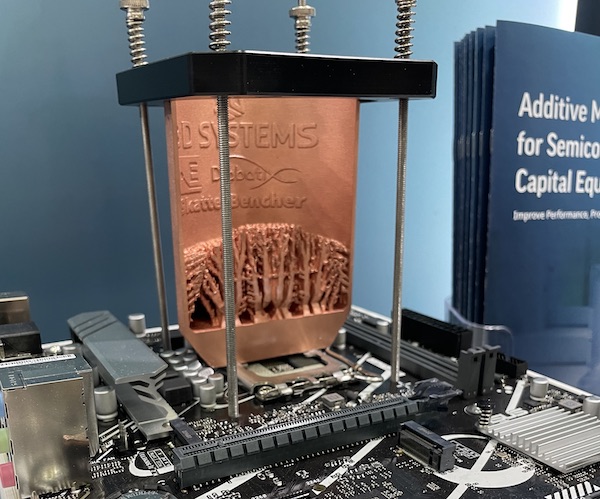
In the 3D Systems booth, there was an example of a copper heat sink designed using AI. (You can learn more about this application in our recent case study.) Patrick Dunne, vice president of advanced application development at 3D Systems, noted that AI was enabling design automation leveraging physics and large language models (LLMs). “The impact LLms have is not only enabling step changes in the function of a component, but also in designing the aesthetics of the part,” he said. “We’re just midway through this journey.”
HP, for example, demonstrated its impressive HP AI Text to 3D solution, which allows users to generate 3D-printable files from simple text prompts. At NVIDIA GTC 2025, HP and Shutterstock demonstrated a solution that uses a new AI image generator (built on NVIDIA Edify) to create 3D models that can be printed on HP printers.
AiBuild offers a software that leverages AI for generating toolpaths for hybrid 3D printing and CNC machine environments. It can make generating complex toolpaths easier, and reduces the need for manual coding. At RAPID, the company announced new thermal simulation and optimization capabilities. “The interpass temperature (during printing) is important, because it affects process stability and the mechanical properties of the part,” said Guy Brown, head of research and development at AiBuild during a press conference at the event. According to Brown, the AIBuild tool leverages GPU compute capabilities.
With thermal simulation, users can ensure that thermals are manageable within the print process windows before printing actually starts. The tool automatically generates a finite element mesh from the printing toolpath (taking information like material and environmental conditions into account) and visualizes the thermal simulation of the build. It then optimizes the toolpath through speeds, waits and process parameters to bring the interpass temperature into a safe range. The company plans to expand into full thermo-mechanical simulation later in 2025. The software also includes an AI Copilot for recommending and performing actions.
Another exhibitor, Synera, is an AI-based engineering process automation platform that allows engineers to create complex CAE workflows without coding. The workflows can be shared with other stakeholders via a web browser. The platform also automates training data generation, can be used to train reduced order models (ROMs), and can interact with GenAI. The company is a member of the Altair Partner Alliance, and has built connectors for other common engineering software tools from Ansys, Siemens, Dassault, PTC and more.
Vixiv (which was originally called Voxel) from Cincinnati, Ohio, offers an AI-based tool that helps engineers explore the design space to find the right lattice structures to reduce weight in their models based on strength, stiffness, manufacturability and other parameters.
As company CEO and co-founder Aaron Chow describes it, the tool cuts out a lot of trial and error that would otherwise go into identifying the best design options, and does so in just a few minutes. The beta release of the software is due in June 2025. Right now, the company is training its AI models using real-world test and validation data from actual printed lattices the company is building at its facilities.
To learn more about the RAPID+TCT 2025 program, visit the event website.


Brian Albright is the editorial director of Digital Engineering.
Contact him at [email protected].






About Us · Contact Us · Editorial Team · Advertising · Privacy Policy · Subscriber Services · © 2026 Digital Engineering 24/7 · Peerless Media