Helping design and engineering professionals discover, evaluate and specify technologies and processes that shorten the design cycle and enable success.


Alert!
Digital Engineering ceased publication on July 1, 2026. This website remains available as an archive of engineering content.
For inquiries or information, please email [email protected].

Digital Engineering April 2026
In the latest issue of Digital Engineering, we take a look at the latest innovations in design for additive manufacturing, including the use of natural language inputs, social media cosplayers, and AI integration. The issue also includes a feature…

January Special Focus Issue: Design for Additive
In this Special Focus Issue of Digital Engineering, learn about the latest advancements in design for additive manufacturing, including new software tools, additive in automotive, custom medical devices, and more.
UK based Fripp Design is looking to add to the potential of 3D printed prosthetics with its development of AM-built facial prosthetics. Through careful material selection and model design, the company is planning to offer nose, ear and eye prosthetics. Not only will these prosthetics be less expensive than the custom, hand-crafted models currently used, they will also be available in a fraction of the time. A prosthetic could be ready in days, rather than the months currently required.
In order to build realistic nose and ear prosthetics that match the skin tone and original features of a patient, Fripp Design is working with the University of Sheffield to develop mapping procedures. Previous scans of the area are used, if available, to design the new prosthetic, and if no previous scans are available, the company relies on stock images.
With design in hand, Fripp Design first ensures the skin color match before beginning the print process using bio-compatible starch and silicone to build the soft-tissue prosthesis. The actual printing work is done on a Z-Corp Spectrum Z510. While the end result isn’t quite as realistic as a hand-crafted prosthetic, the reduced price tag could be appealing to those without the means to commission a more detailed piece.
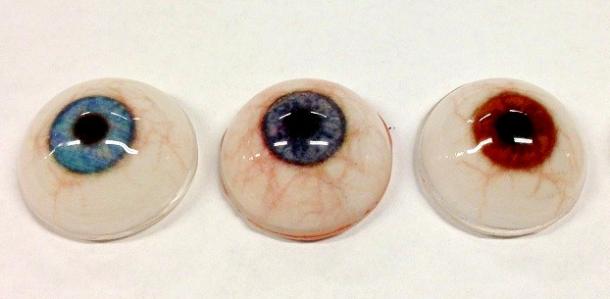
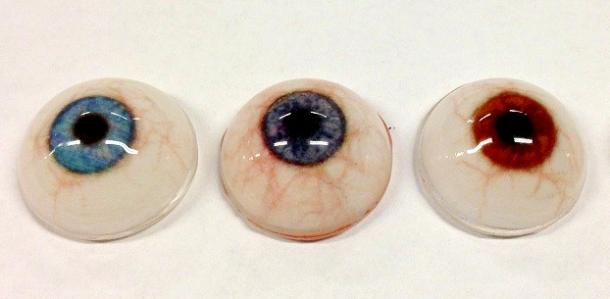
Prosthetic eyes are another area to which Fripp Design intends to introduce AM creations. The company has entered into an arrangement with the Manchester Metropolitan University (MMU) to assist with this particular design challenge, resulting in a batch production process that could allow Fripp Design to print up to 150 prosthetic eyes per hour.
Eyes are color printed, including details such as veins and iris color, and then encased in resin. Currently, a prosthetic eye might cost as much as $4,800. 3D printed eyes could be produced for a little as $163, and Fripp Design is working with MMU to produce a stock of ready-made prosthetics that could be purchased for under $50. The company is predicting its entire prosthetics line will be ready to go no later than fall 2014.
Below you’ll find a short video about Fripp Design.


John Newman is a Digital Engineering contributor who focuses on 3D printing. Contact him via [email protected] and read his posts on Rapid Ready Technology.
Follow DE






About Us · Contact Us · Editorial Team · Advertising · Privacy Policy · Subscriber Services · © 2026 Digital Engineering 24/7 · Peerless Media