Helping design and engineering professionals discover, evaluate and specify technologies and processes that shorten the design cycle and enable success.




Digital Engineering April 2026
In the latest issue of Digital Engineering, we take a look at the latest innovations in design for additive manufacturing, including the use of natural language inputs, social media cosplayers, and AI integration. The issue also includes a feature…

January Special Focus Issue: Design for Additive
In this Special Focus Issue of Digital Engineering, learn about the latest advancements in design for additive manufacturing, including new software tools, additive in automotive, custom medical devices, and more.
This week, the breakthrough comes from a GE Aviation branch in Italy, Avio Aero. Researchers have developed a more powerful method of electron beam melting to build metal blades for jet engines. The beam is generated from a 3 kW laser and is, according to the company, 10x more powerful than comparable capabilities of any other AM system.
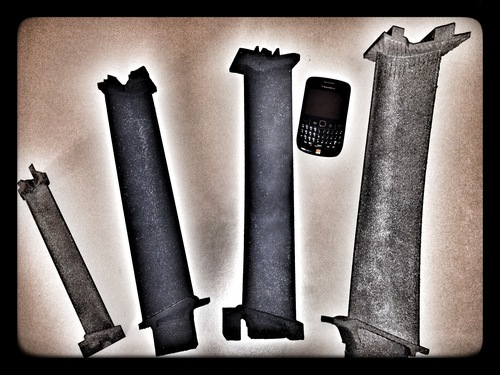 From left to right, Avio 3D-printed blades for the LEAP, GEnx, GE90 and GE9X jet engines. Courtesy of GE Aviation.
The increase in power has allowed Avio Aero to produce blades that are four times thicker than previously possible. A thicker blade means the company requires just 72 hours to build eight stage 7 blades for the low pressure turbine inside the GEnx jet engine. The new process is competitive in both time and money saved when compared to more traditional manufacturing methods.
“This is very competitive with casting, which is how we used to make them,” said Mauro Varetti, AM engineer at Avio. “Although the material is expensive, the weight savings and the fuel consumption savings tied to weight reduction more than pay for it.”
The weight savings come from using an alloy called titanium aluminide, which was designed for use in aerospace. The material can produce parts that are up to 50% lighter than those made using the general industry standard nickel-based alloys. In this case, total weight savings can reduce the weight of the entire low pressure turbine by 20%.
This fall, GE Aviation will begin testing the new blades for use in the GEnx engine at facilities in Peebles, OH. Blades made using the same process could also be used for the GE9X, a new jet engine being developed for Boeing’s forthcoming 777X.
This sort of progress is what you might expect from a company hoping to move units, rather than for in-house work. Nor is GE Aviation alone. Rolls Royce is also investigating how it can make AM part of its production process for jet engines.
Below you’ll find a short video about jet engines.
Source: GE


John Newman is a Digital Engineering contributor who focuses on 3D printing. Contact him via [email protected] and read his posts on Rapid Ready Technology.
Follow DE
Join over 90,000 engineering professionals who get fresh engineering news as soon as it is published.






About Us · Contact Us · Editorial Team · Advertising · Privacy Policy · Subscriber Services · © 2026 Digital Engineering 24/7 · Peerless Media