Helping design and engineering professionals discover, evaluate and specify technologies and processes that shorten the design cycle and enable success.




Digital Engineering April 2026
In the latest issue of Digital Engineering, we take a look at the latest innovations in design for additive manufacturing, including the use of natural language inputs, social media cosplayers, and AI integration. The issue also includes a feature…

January Special Focus Issue: Design for Additive
In this Special Focus Issue of Digital Engineering, learn about the latest advancements in design for additive manufacturing, including new software tools, additive in automotive, custom medical devices, and more.
MatterFab, an AM manufacturing startup, has gained industry attention for its work in developing a new metal 3D printer. GE Ventures has invested $5.75 million into MatterFab in hopes of producing an metal AM system that is faster, scalable and less expensive than those currently available on the market.
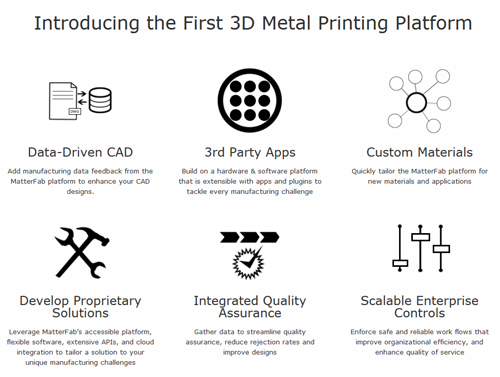 A few of the expected features for MatterFab's first AM system. Courtesy of MatterFab.
From the GE Ventures blog:
From aircraft parts, to oil and gas production, to healthcare tools, GE has a long-standing interest in manufacturing. Now, we’re focused on reinventing the way we work, with advanced manufacturing techniques that are driving the next industrial revolution. Additive manufacturing allows us to build precise parts and products across our industries of focus, with flexibility and scale that was previously impossible.
GE has already put its money where its mouth is in terms of AM with a number of projects and investments meant to put it at the forefront of AM technology for aviation, and oil and gas production. While other companies are still struggling to come to terms with the new technology, GE is blazing new trails.
MatterFab caught GE’s attention as a result of the quality of parts produced by the startup’s prototypes. Additionally, MatterFab’s system uses third-party apps and development tools already used in the manufacturing sector, making it easier for new customers to adapt to building and designing AM parts. Use of existing tools also frees MatterFab to concentrate on building the best AM platform possible without having to worry about software design.
While no technical specs are yet available for the system, MatterFab intends to begin full-scale production of the 3D printer later this year, with shipping to begin the following summer. Below you’ll find a video about MatterFab.
Sources: TechCrunch, GE Ventures


John Newman is a Digital Engineering contributor who focuses on 3D printing. Contact him via [email protected] and read his posts on Rapid Ready Technology.
Follow DE
Join over 90,000 engineering professionals who get fresh engineering news as soon as it is published.






About Us · Contact Us · Editorial Team · Advertising · Privacy Policy · Subscriber Services · © 2026 Digital Engineering 24/7 · Peerless Media