Helping design and engineering professionals discover, evaluate and specify technologies and processes that shorten the design cycle and enable success.


Alert!
Digital Engineering ceased publication on July 1, 2026. This website remains available as an archive of engineering content.
For inquiries or information, please email [email protected].

May 2026 Special Focus: Artificial Intelligence in Design and Simulation
In this Special Focus Issue, learn about the latest developments in the integration of artificial intelligence into engineering workflows.

April 2026 Special Focus Issue: Generative Design
In this Special Focus Issue, Digital Engineering takes a look at how generative design solutions can be used across different types of design problems and with a variety of manufacturing approaches to accelerate design space exploration, and…
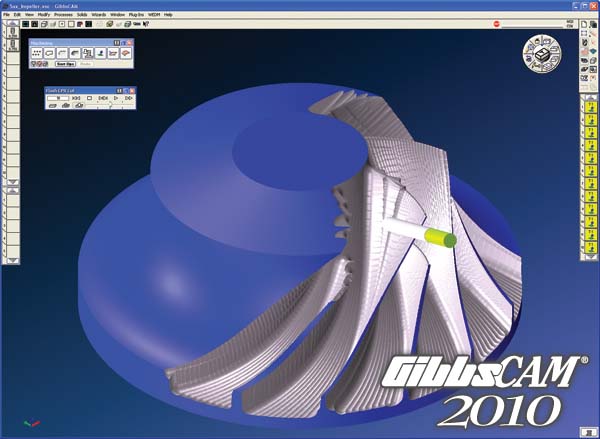
Gibbs and Associates is now shipping GibbsCAM 2010 software for maximizing the programming efficiency of CNC machine tools. This new release includes multiple new features, additions, enhancements, and productivity tools.
 |
“We have been working very hard to provide customers new functionality across the GibbsCAM product family,” says Bill Gibbs, founder and president of Gibbs and Associates. “We added many capabilities to make programming and machining easier and more efficient, especially with new features in 5-axis and solids machining. We also implemented 64-bit operation to enable faster processing of long programs and complex parts, added support for new tools and tool holders, extended functionality within various modules, and extended and updated interoperability with various CAD systems. All this is in addition to the recent integration of VoluMill and making GibbsCAM compatible with the Windows 7 operating system.”
GibbsCAM 5-axis enhancements include more spiral machining options, new gouge check projection options, a new lead in/lead out “flip” option, a new axial shift damp option for trimming applications, and support for countersink and keyway cutters.
Enhancements to solids machining include new, more capable plunge roughing. No longer a plug-in, plunge roughing is now a tile in the CAM palette, with the ability to calculate material removal strategies that accommodate carbide-inserted drills.
GibbsCAM 2010 also includes the addition of Hit Flats with specified tools for pocketing, the ability to specify flatness tolerance in flats cut to ensure all desired “flat” areas are machined, a locking high-feed rate for shortest route and minimal vertical retract styles, addition of Trim to Ramp Advance as a Contour option for waterline cuts, and using Stock Bounding Box as an additional machining boundary.
The 64-bit implementation allows users to take advantage of multi-processor PCs equipped with 4GB or more of RAM. This provides tighter interoperability with 64-bit CAD systems that are co-resident with GibbsCAM on a PC. Also, 64-bit operation reduces computation time when processing extremely long programs or working with complex geometry. It will also enable users to take advantage of system enhancements when running under the Windows 7 operating system.
For more information, visit Gibbs and Associates.
Sources: Press materials received from the company and additional information gleaned from the company's website.


DE's editors contribute news and new product announcements to Digital Engineering. Press releases may be sent to them via [email protected].
Follow DE






About Us · Contact Us · Editorial Team · Advertising · Privacy Policy · Subscriber Services · © 2026 Digital Engineering 24/7 · Peerless Media