Helping design and engineering professionals discover, evaluate and specify technologies and processes that shorten the design cycle and enable success.


Alert!
Digital Engineering ceased publication on July 1, 2026. This website remains available as an archive of engineering content.
For inquiries or information, please email [email protected].

May 2026 Special Focus: Artificial Intelligence in Design and Simulation
In this Special Focus Issue, learn about the latest developments in the integration of artificial intelligence into engineering workflows.

April 2026 Special Focus Issue: Generative Design
In this Special Focus Issue, Digital Engineering takes a look at how generative design solutions can be used across different types of design problems and with a variety of manufacturing approaches to accelerate design space exploration, and…
The field of prosthetics has been shaken up by AM in a thorough enough fashion for the technology to warrant its oft-used “disruptive” description. In place of prosthetics that cost thousands of dollars, AM has made it possible to produce prosthetics for tens of dollars. Recently, Google has made it possible for more people to gain access to a prosthetic hand by donating $600,000 to Enable.
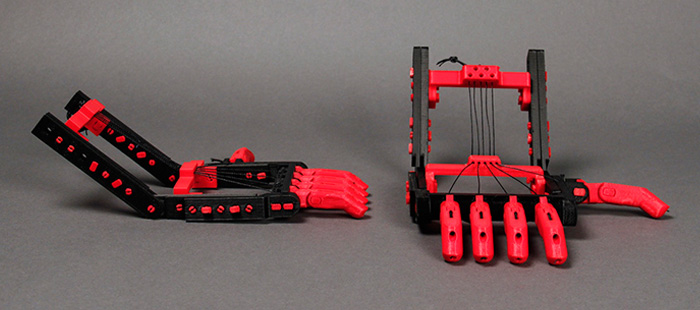
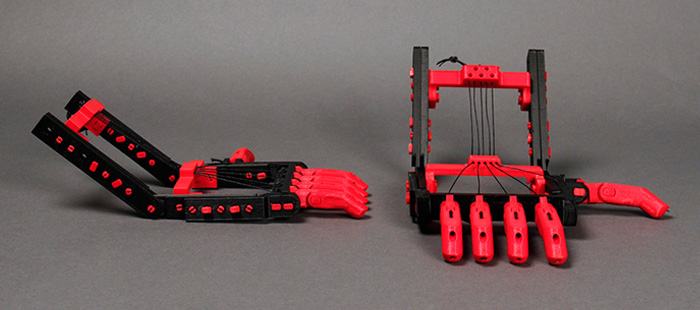 Robohand was a step forward for inexpensive prosthetic design. Courtesy of MakerBot.
A little over two years ago, Rapid Ready reported on a child that had received the gift of a 3D printed prosthetic hand from an unlikely partnership between a South African carpenter and a PLC Programmer/automation technician living in Washington. Further collaboration on their part resulted in an improved prosthetic design, which they called Robohand.
Those early steps, and the fact that the digital plans for the prosthetics hands were shared via the Internet, eventually led to the founding of Enable (or e-Nable). The group is connected by the Internet, and by a desire to improve the lives of those who require prosthetic hands. The community has designed a variety of prosthetics, and Enable offers them for free to those in need.
Of course, printing out and fitting someone for a prosthetic hand is a little more difficult than just buying the required materials (which cost about $35). Each individual user requires tweaks to the design or to the finished product to ensure comfort and usability. The Enable community assists new users either directly or by way of online communications to ensure each new prosthetic works as well as possible.
Inexpensive prosthetics are one of the best examples of how AM can shake up an industry. Below you’ll find a video about Enable.
Source: Enable


John Newman is a Digital Engineering contributor who focuses on 3D printing. Contact him via [email protected] and read his posts on Rapid Ready Technology.
Follow DE






About Us · Contact Us · Editorial Team · Advertising · Privacy Policy · Subscriber Services · © 2026 Digital Engineering 24/7 · Peerless Media