Helping design and engineering professionals discover, evaluate and specify technologies and processes that shorten the design cycle and enable success.


Alert!
Digital Engineering ceased publication on July 1, 2026. This website remains available as an archive of engineering content.
For inquiries or information, please email [email protected].

Digital Engineering April 2026
In the latest issue of Digital Engineering, we take a look at the latest innovations in design for additive manufacturing, including the use of natural language inputs, social media cosplayers, and AI integration. The issue also includes a feature…

January Special Focus Issue: Design for Additive
In this Special Focus Issue of Digital Engineering, learn about the latest advancements in design for additive manufacturing, including new software tools, additive in automotive, custom medical devices, and more.
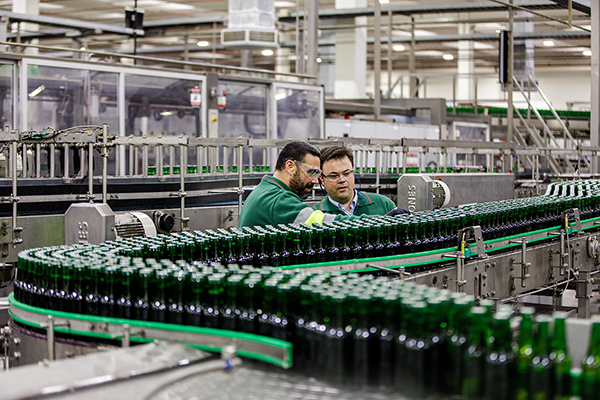
Ultimaker announces that Heineken is using its solutions to produce a variety of custom tools and functional machine parts to aid in manufacturing at the company’s brewery in Seville, Spain. Using a set of Ultimaker S5 printers, engineers at Heineken now design and print safety devices, tools and parts on-demand rather than outsourcing the job to external vendors, increasing production uptime and saving around 80% in production costs on the parts they 3D print, according to Ultimaker.
“We’re still in the first stages of 3D printing, but we’ve already seen a reduction of costs in the applications that we found by 70%-90% and also a decrease of delivery time of these applications of 70%-90%,” says Isabelle Haenen, global supply chain procurement at Heineken. “Local manufacturing helps us a lot in increasing uptime, efficiency and output. We use 3D printing to optimize the manufacturing line, create maintenance and quality control tools, and create tools for our machines which help us increase safety for our people. I think there will be even more purposes in the future.”
The Sevilla brewery produces several brands of Heineken-owned beers, amounting to up to 500 million liters of beer per year. The engineers at Heineken have been using 3D printing for about one year, first using the Ultimaker 2+ and now multiple Ultimaker S5 printers, a larger, enterprise-ready machine. The 3D printing technology was first used for safety applications, but the engineers soon began creating custom optimized functional parts for machines from the manufacturing line. The variety of use cases now include:
Applications to increase the uptime of the production line: Heineken 3D prints functional parts for its machines. By printing the spare parts on-demand, the company avoids operational downtime because there is no need to have an inventory and no need to wait for part deliveries.
Optimizing part designs: The team was able to replace various redesigned parts with an optimized design. For example, a metal part used with the quality sensor on the conveyor belt would often knock bottles over, creating a blockage, or eject good bottles onto the ground. The redesigned 3D printed part prevents this, saving bottles, money and time.
Tools for quality control and maintenance: Heineken has also created completely new tools that make it easier to perform maintenance or check the quality of products or machines. These tools help prevent machines from not working correctly or breaking down.
Solutions to increase operator safety: To keep its workers as safe as possible, Heineken has also looked for ways to make smart, 3D-printed tools that prevent accidents.
“Every company has its own unique challenges in the production process, which is why the ability to create custom solutions straight from the factory floor is such a game-changer for the manufacturing industry,” says Jos Burger, CEO of Ultimaker. “Heineken is a prime example of a company that’s utilizing the Ultimaker S5 as an all-purpose manufacturing machine. We have enjoyed watching the use case evolve over the past year, from safety applications to the creation of fully functional parts for machines that lead to significant savings, and we cannot wait to see what they come up with next.”
Sources: Press materials received from the company and additional information gleaned from the company’s website.


From the very beginning, our mission has been to accelerate the world’s transition to local manufacturing and digital distribution. Our passion is to deliver a 3D printing system that drives business success across the world. That’s why…

Insider Q&A: 3D Printing End Use Parts
In this Insider Q&A, the experts at Ultimaker explain how 3D printing can be used for spare parts, jigs and fixtures in a production environment.

DE's editors contribute news and new product announcements to Digital Engineering. Press releases may be sent to them via [email protected].
Follow DE






About Us · Contact Us · Editorial Team · Advertising · Privacy Policy · Subscriber Services · © 2026 Digital Engineering 24/7 · Peerless Media