Helping design and engineering professionals discover, evaluate and specify technologies and processes that shorten the design cycle and enable success.




Design & Simulation Software Guide 2025
In this Special Issue, Digital Engineering presents its second annual guide to design and simulation software vendors.

Special Focus Issue: Artificial Intelligence in Simulation
In this Special Focus Issue of Digital Engineering, we look at the latest trends in integrating AI and machine learning with design and simulation tools. The issue includes features on synthetic data, open-source AI for modeling, AI-powered…
Hexagon’s Manufacturing Intelligence division and Stratasys have applied Hexagon’s simulation technology to capture the behavior of Stratasys’ high-performance, lightweight Antero reinforced polyetherketoneketone (PEKK) materials and its additive manufacturing processes. These validated simulations offer Stratasys customers insight so they can lightweight components and introduce new sustainable aircraft and spacecraft faster, the companies report.
Validated multi-scale models of new high-performance aerospace-approved materials—Stratasys Antero 840CN03 and Antero 800NA—have been added to Hexagon’s Digimat materials exchange ecosystem, with associated print process parameters from Stratasys’ aerospace-ready 3D printers. Using these detailed models, engineers can create digital twins that predict how parts printed with the chosen material and approved aerospace-ready Stratasys printer will perform in a digital reality with real-world use cases and certification tests before physical prototypes are manufactured.
Developed to be open, Digimat software gives manufacturers ability to design lighter parts that can match metals in performance and avoid over engineering using finite element analysis and computer-aided engineering tools. Companies that use Digimat in conjunction with Hexagon’s MSC Nastran and MSC Apex will accelerate the certification and documentation of their work, according to the companies.
“As the aerospace industry continues to push for more sustainable designs, unlocking the lightweighting potential of thermoplastics and 3D printing will be key," says Aziz Tahiri, vice president of global aerospace and defense for Hexagon’s Manufacturing Intelligence division. "By leveraging the power of our simulation technology, manufacturers gain access to proprietary information so their engineers can ‘work the problem’ with reliable information. We’re excited to see how this next chapter with Stratasys will help the industry create lighter, stronger designs in any design engineering tool with more confidence and less cost and help bring next-gen aircraft to market faster.”
“The Antero 840CN03 and Antero 800NA thermoplastics provide unprecedented strength, heat and chemical resistance," says Foster Ferguson, aerospace business segment leader, Stratasys. "When combined with Hexagon’s simulation insights and actionable data, these 3D printed materials’ ability to replace certain applications of aluminum and steel clearly points to growing use in the aerospace industry. We believe they meet manufacturers’ increasingly complex performance needs, and by combining innovative modeling software with 3D printing, can reduce production timelines from months to days.”
Through the partnership between Stratasys and Hexagon, which has spanned more than a decade, several high-performance thermoplastic materials—including Ultem 9085, Ultem 9085 CG, Ultem 1010 and Nylon12CF—have been characterized and added to Hexagon’s Digimat material modeling software.
Sources: Press materials received from the company and additional information gleaned from the company’s website.


Every day, our customers find simpler, smarter approaches to stubborn design problemsand greater confidence to confront towering human and technological challenges. Less hindered by the usual constraints, they can imagine, design, iterate and…
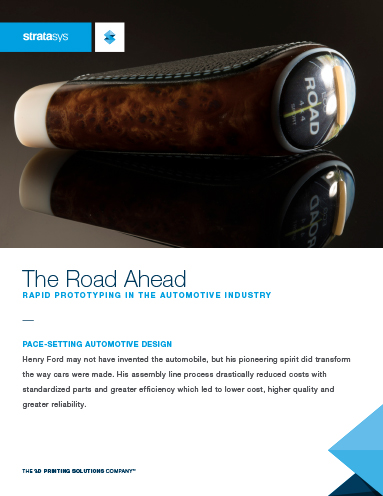
Rapid Prototyping in The Automotive Industry
Henry Ford may not have invented the automobile, but his pioneering spirit did transform the way cars were made. His assembly line process drastically reduced costs with standardized parts and greater efficiency which led to lower cost, higher quality and greater reliability.

DE's editors contribute news and new product announcements to Digital Engineering. Press releases may be sent to them via [email protected].
Follow DE
Join over 90,000 engineering professionals who get fresh engineering news as soon as it is published.






About Us · Contact Us · Editorial Team · Advertising · Privacy Policy · Subscriber Services · © 2026 Digital Engineering 24/7 · Peerless Media