Helping design and engineering professionals discover, evaluate and specify technologies and processes that shorten the design cycle and enable success.



Design & Simulation Software Guide 2025
In this Special Issue, Digital Engineering presents its second annual guide to design and simulation software vendors.

Design & Simulation Software Guide
In this Special Issue, Digital Engineering presents its inaugural guide to design and simulation software vendors, including listings for CAD, CAM, simulation, generative design, PLM, rendering and visualization, design for additive manufacturing,…
For a data scientist mining the predictive patterns buried in the field data from a roadside pump or manufacturing plant, the rows of real-time data represent a digital twin, a representation of what’s occurring on the ground. For an engineer perfecting the self-navigation system of an autonomous vehicle, the digital twin is more likely a detailed 3D model capable of replicating the car’s electromechanical behaviors.
In appearance, these two types of twins seem a world apart. However, according to many experts, data and simulation are critical aspects of digital twins. The twin loses a significant number of advantages if it’s constructed with one and not the other. In this article, we examine how data-centric twins and simulation-driven twins corroborate and complement each other.
Simulation-driven digital twins are usually made possible by physics-based simulation software, such as finite element analysis (FEA) and computational fluid dynamics (CFD) packages. Recently, leading software developers in this area are beginning to integrate reduced order models (ROMs), which use existing simulation data and machine learning methods to simplify the process and reduce processing time.
In many cases, the new approach allows the software to bypass running full physics-based simulation and make predictions based on past simulation results. Therefore, the line dividing data-driven and simulation-driven digital twins is getting blurry.
“A comprehensive digital twin brings together many different elements,” says Dale Tutt, vice president of Industry Strategy, Siemens Digital Industries Software. “It may have a 3D model, a model for structural analysis or vibration study. It also has empirical data. All of these are parts of a comprehensive twin.”
A simulation model is essential for making predictions because “you need to be grounded in physics,” notes Tutt. “But you can’t have a simulation model without data. If you model a flight control system, you model it using physics, but then you would validate it using flight test data.”
“When people think of the digital representation of a physical asset, they tend to think of the model that shows the shape and structure,” says Lawrence Benson, vice president of Lifecycle Solutions Strategy, Hexagon. “But it doesn’t really come to life unless you add the contextual data and behavior to it.”
In 2018, Hexagon acquired MSC Software, adding the latter’s computer-aided engineering (CAE) products to its portfolio. Today, Hexagon offers FEA, CFD, and multibody dynamics simulation packages under the HxGN brand. Simulation-driven twin builders may turn to those products. The company also offers data-driven twin solutions from its Asset Lifecycle Intelligence (ALI) division.
When an asset is in operation, it becomes possible “to take the historical data and make predictions about the future,” notes Philipp Wallner, Industry Manager, MathWorks. “In my experience, in industrial automation, manufacturing, and energy production, I haven’t come across a digital twin that’s solely data-driven, or solely simulation-driven.”
The most mature digital twin operators, he notes, use a combination of the two, making the twin a hybrid of data and simulation.
Wallner notes there may be circumstances where a data-driven twin is easier to construct than a simulation-driven one. “If you don’t have enough knowledge or expertise about the dynamics of a mechatronics system, for example, you’ll likely favor the data-driven approach. On the other hand, if you still lack real-time data from the device, but you have reasonable expertise about your device, then you’ll gravitate toward the simulation-driven twin.”
Tutt adds, “If you’re trying to understand an automobile or aerospace system, it involves physics, so you might want to build a simulation-driven model. On the other hand, if you want to understand costs or carbon emissions, then you may want a data-driven model.”
“The appeal of the data-driven twin is, the time-to-value is very quick, and you can deploy them quickly. Simulation-driven twins are usually bespoke, so you need to do an engineering study of a piece of asset first,” observes Benson. “With machine learning, it’s fairly easy to build a data-driven model of a pumping unit and deploy it across several refineries. But it’s like a black box, so you can make predictions, but you can’t really explain the phenomenon. If you need to explain or understand what’s happening in the unit, then you’ll need a physics-based model.”
Physics-based simulation models are much more compute-intensive, and harder to scale since it’s built to mimic a specific operation. The best approach, Benson reasons, is to use the physics-based simulation model to see if it recreates the results in the machine-learning data-driven model, as a way to test its reliability.
MathWorks offers MATLAB, Simulink, and Simscape as part of its digital twin solutions. “MATLAB family of products are data analysis tools with machine learning features, so they help you analyze large datasets,” explains Wallner. “Simulink and Simscape help you build models of mechatronics systems and simulate them.”
One of MathWorks’ customers is Atlas Copco. The company relied on MATLAB and Simulink to build their Model-Based Engineering Platform. “Current models of Atlas Copco compressors are equipped with up to 50 sensors, preparing them for predictive maintenance, and the service division can set up customer-specific maintenance strategies based on real-time data collection from more than 100,000 machines in the field, creating a wealth of insights they have only just begun to explore,” according to MathWorks.
The company deployed its digital twin in a web interface, Wallner recalls. “This allows not only their engineers but also their sales and marketing teams that do not use MATLAB or Simulink to access it, make queries and run parameter sweeps,” he explains.
To build a data-driven model, a steady stream of real-time data or a robust archive of historical data is critical. Without it, the twin builder will have to rely on synthetic data, produced mathematically using theories. (For more on this, read “When Real-World Data is Not Enough,” June 2023.)
“The quality of data is probably the greatest challenge,” notes Benson. “Companies captured lots of maintenance data. But they don’t understand how that has changed over time. The way they captured failure modes in the past might have been different, for example. And the data collected might also be sensitive to the drift in instruments [error from a gradual shift in the gauge’s measured value over time].”
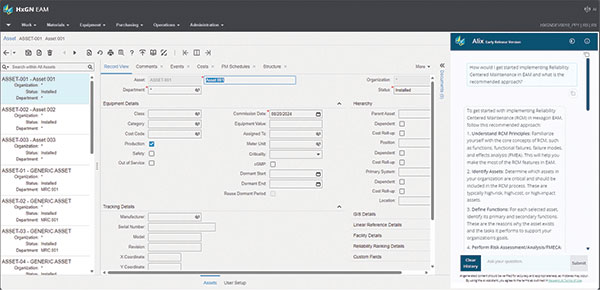
Support for natural language allows users to ask questions using everyday English. Image courtesy of Hexagon.
In the future, querying the digital twins for anomalies might get easier, as the integration of natural language is becoming a regular feature of digital twin software. In November 2024, Hexagon launched HxGN Alix, an AI-powered assistant to probe and identify insights buried in datasets in heavy asset industries and industrial enterprises.
“By embedding AI-driven insights into daily operations, we’re empowering organizations to predict and prevent issues before they arise, enhance worker productivity and, ultimately, make industrial facilities safer and more efficient,” says Javier Buzzalino, senior vice president Solution Development, Hexagon’s Asset Lifecycle Intelligence division. “HxGN Alix exemplifies Hexagon’s commitment to delivering pragmatic, data-secure solutions that address the evolving needs of our customers in asset-heavy industries.”


Simcenter™ software, from Siemens Digital Industries Software, uniquely combines system simulation, 3D CAE and test to help you predict performance across all critical attributes earlier and throughout the entire product lifecycle. By combining…
Making the Case for Artificial Intelligence and Machine Learning in Engineering
In this paper, Siemens Digital Industries Software and Digital Engineering will provide an overview of how AI/ML-enabled software can improve design workflows, while also addressing common questions and concerns around implementing this technology in an engineering organization.

Kenneth Wong is Digital Engineering's resident blogger and senior editor. Email him at [email protected] or share your thoughts or suggestions at digitaleng.news/facebook.
Follow DE
Join over 90,000 engineering professionals who get fresh engineering news as soon as it is published.






About Us · Contact Us · Editorial Team · Advertising · Privacy Policy · Subscriber Services · © 2026 Digital Engineering 24/7 · Peerless Media