Helping design and engineering professionals discover, evaluate and specify technologies and processes that shorten the design cycle and enable success.


Alert!
Digital Engineering ceased publication on July 1, 2026. This website remains available as an archive of engineering content.
For inquiries or information, please email [email protected].

Digital Engineering April 2026
In the latest issue of Digital Engineering, we take a look at the latest innovations in design for additive manufacturing, including the use of natural language inputs, social media cosplayers, and AI integration. The issue also includes a feature…

January Special Focus Issue: Design for Additive
In this Special Focus Issue of Digital Engineering, learn about the latest advancements in design for additive manufacturing, including new software tools, additive in automotive, custom medical devices, and more.
A new partnership between 3D printer and materials company Impossible Objects and 3D printing specialist Ricoh 3D will make strong and lightweight printed composite parts available to Ricoh 3D’s customers in Europe for the first time.
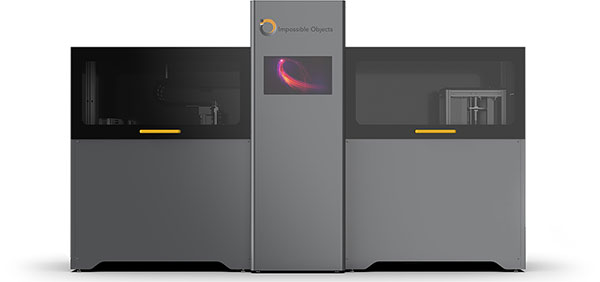
Impossible Objects’ composite-based additive manufacturing (CBAM) process enables the production of stronger parts at costs lower than any other 3D printing process.
“Composites are set to be an area of huge growth in additive manufacturing in the coming years. These new materials will change the game across a number of industries,” says Mark Dickin, Additive Manufacturing & Molding Engineering manager at Ricoh 3D. “Impossible Objects’ CBAM process is nothing short of a revolution in the way composites are manufactured, so we are proud to be working with the company to be at the forefront of the European movement.”
Composites including Carbon Fiber PEEK and Carbon Fiber PA12 are available through Ricoh 3D’s AM service bureau immediately.
“Our CBAM process represents a significant leap forward in 3D printing, with faster speeds, better material properties and wider material selection,” says Robert Swartz, chairman and founder of Impossible Objects. “Fortune 100 companies, government agencies, and more have already put it to work to create everything from car and aircraft parts to athletic gear. By collaborating with the team at Ricoh 3D who recognizes the transformative potential of additive manufacturing, together we will bring these competitive advantages to more organizations across Europe.”
Impossible Objects’ CBAM technology can produce parts up to 10 times faster than conventional fused deposition modeling (FDM) 3D printing, the company reports. By combining high-performance polymers like Nylon and PEEK with carbon fiber and fiberglass sheets, parts printed with Impossible Objects machines are strong, light, with dimensional accuracy and temperature performance. The CBAM process can create strong and resilient fine or flat parts.
Ricoh 3D is the latest industry partner to join forces with Impossible Objects to drive additive manufacturing forward. Other collaborators include BASF and TIGER Coatings.
Watch a video about the CBAM process.
Data sheets about printing with CBAM through Ricoh 3D are here.
Sources: Press materials received from the company and additional information gleaned from the company’s website.


DE's editors contribute news and new product announcements to Digital Engineering. Press releases may be sent to them via [email protected].
Follow DE






About Us · Contact Us · Editorial Team · Advertising · Privacy Policy · Subscriber Services · © 2026 Digital Engineering 24/7 · Peerless Media