Helping design and engineering professionals discover, evaluate and specify technologies and processes that shorten the design cycle and enable success.


Sponsored
 Dear DE Reader:
Recently, an engine exploded on a Southwest flight at cruising altitude. Pieces of the engine nearly penetrated the main fuselage. It'll take months of forensic analysis to know what happened, but this anomalous event underscores the importance of rigorous safety testing of aircraft components. Today's Check it Out link takes you to a paper on simulating fan blade failure to prevent fragments from escaping the engine case and damaging an aircraft.
“LS-DYNA Performance Enhancement of Fan Blade Off Simulation on the Cray XC40 Supercomputer” will grab your attention no matter what kind of simulation you perform. It's rich in technical details for hands-on analysts, and it provides a wealth of data for engineering IT managers responsible for providing the power to make such simulations possible. For C-level managers, the potential productivity gains described will make you sit up.The outline is that a team of engineers from Cray, Livermore Software Technology Corp. (LSTC) and Rolls-Royce sought to speed up the performance of an FEA (finite element analysis) simulation of a fan blade off containment test. The issue at hand is that simulating a typical jet engine fan blade off containment test is time-consuming, technically challenging and compute-intensive. It can involve millions of elements and take up to four weeks to run. The goal was to improve performance and parallel scaling so that they could obtain results in 24 hours. They got results in 21 hours—34 times better. Scaling improved dramatically.
The FEA software is LSTC's LS-DYNA, and the paper provides a comparison of simulations run with a newer version of LS-DYNA and its predecessor. Both medium-size (24 million elements) and large models (80.6 million elements) were simulated on a Cray XC40 supercomputer. A Cray profiling tool helped identify LS-DYNA's most time-consuming subroutines, which were then optimized and incorporated in the new version. This resulted in a 30 percent memory usage reduction.
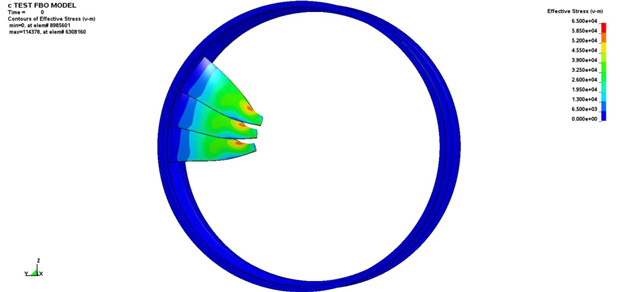 This medium-size model of a fan blade off containment structure consists of 26.5 million nodal points and 24 million solid elements. Here, the three fan blades represent the fan blades rotating in a stationary engine case. Explicit LS-DYNA used a constant rotation speed to set the initial stress state of the blades prior to the fan blade off simulation. LS-DYNA image courtesy of Cray Inc.
The paper also provides an analysis of the MPI (message passing interface) communication patterns and load balance among the MPI processes in the fan blade off containment simulation. This analysis, derived with another Cray tool, provided important clues on how scalability might be enhanced further.
“LS-DYNA Performance Enhancement of Fan Blade Off Simulation on the Cray XC40 Supercomputer” is a data-filled, no malarkey technical paper that'll make it hard to contain your inner geek. Hit today's Check it Out link for your complimentary copy.
Thanks, Pal. – Lockwood
Anthony J. Lockwood
Editor at Large, DE


Anthony J. Lockwood is Digital Engineering's founding editor. He is now retired. Contact him via [email protected].
Follow DE
Join over 90,000 engineering professionals who get fresh engineering news as soon as it is published.






About Us · Contact Us · Editorial Team · Advertising · Privacy Policy · Subscriber Services · © 2026 Digital Engineering 24/7 · Peerless Media