Helping design and engineering professionals discover, evaluate and specify technologies and processes that shorten the design cycle and enable success.



May 2026 Special Focus: Artificial Intelligence in Design and Simulation
In this Special Focus Issue, learn about the latest developments in the integration of artificial intelligence into engineering workflows.

April 2026 Special Focus Issue: Generative Design
In this Special Focus Issue, Digital Engineering takes a look at how generative design solutions can be used across different types of design problems and with a variety of manufacturing approaches to accelerate design space exploration, and…
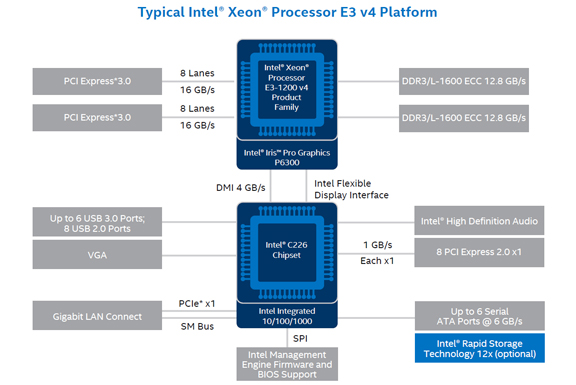
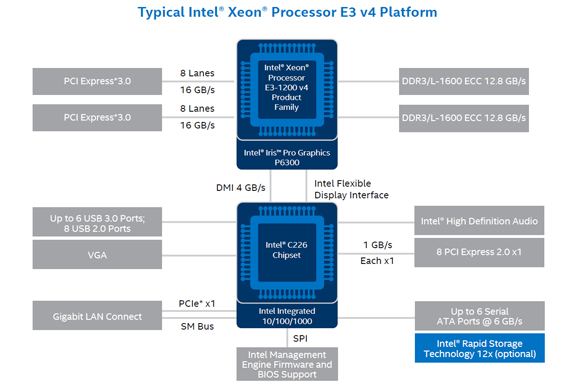 A breakdown of the architecture of Intel Xeon E3-1200 V4
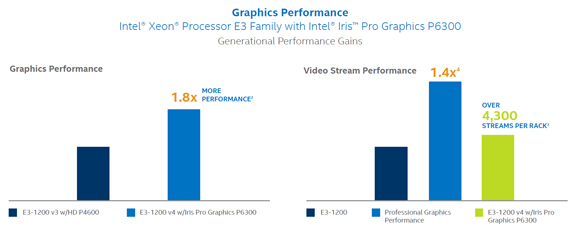 Graphics performance benchmarks of Intel Xeon E3-1200 V4, according to Intel.
Last month, at Computex in Taipei, Taiwan, Intel gave attendees a peek at its upcoming processors, including the new Xeon E3-1200 V4 family for the professional market. As he presented the new lineup in a keynote, Kirk Skaugen, senior VP and GM of the client computing division, hailed Intel Xeon products as "processors that power more than 90% of the world’s data centers."
Featuring Intel's Iris Pro integrated graphics, the Xeon E3-1200 V4 processors are a countermeasure against the encroachment of discrete graphics vendors. Skaugen said, "Intel is beyond CPU performance. We’ve been working on graphics and imaging over the last few years."
For graphics-intensive applications, gamers, engineers, visual artists, and content creators often augment their hardware's processing power with GPUs, a market dominated by NVIDIA and AMD. By incorporating graphics-boosting features right into the processor architecture, Intel hopes to entice those users to rely less on discrete graphics cards.
Skaugen pointed out, "Integrated graphics have a lower bill of materials, smaller footprint, and lower power envelope." In its product sheet for Xeon E3-1200 V4, Intel writes, "The tight integration of compute and graphics in the same processor increases performance and density, while reducing power consumption and data movement."
In a podcast that aired shortly after Computex, Jim Blakley, Intel's GM for visual cloud computing, pointed out that the Xeon E3-1200 V4 offers "substantial performance over previous generations." He added, "We get up to almost 2x in graphics improvement overall, almost 2x in media processing and video transcoding." The improvement is expected to produce "very good user experience for remote workstation kinds of applications," according to Blakley. He singled out "3D rendering, 3D composition, virtual reality, collecting videos and turning it into 3D representations" as operations that can benefit from integrated graphics ("Advancing Cloud Graphics w/ the new Intel Xeon Processor E3-1200 v4 – Intel Chip Chat – Episode 390," June 10, 2015).
According to Intel's own published benchmarks, E3-1200 V4 with Iris Pro Graphics P6300 offers 1.8x graphics performance compared to E3-1200 V3 with HD P4600 graphics.
If Intel's integrated Iris Pro offers visualization comparable to what users currently get from the combination of CPU and professional GPU, the new CPUs can disrupt the workstation and server markets. But the professional application developers' ability to harvest the full power of Iris Pro is a critical factor. Reaping computational benefits from the NVIDIA GPUs is made possible by software makers' willingness to embrace NVIDIA's CUDA parallel programming language.
Those who plan to deploy remote workstations can expect to benefit from Intel Graphics Virtualization Technology (GVT), which allows administrators to dedicate and distribute resources from the processors to remote workers as they see fit. GPU maker NVIDIA is also aggressively pursuing the virtual workstation market with its own NVIDIA Grid products. (For more, read "Don't Install -- Stream!," November 6, 2013).
Xeon E3-1200 V4 is based on Intel's fifth generation Broadwell microarchitecture. The sixth generation microarchitecture codenamed Skylake is expected to debut at Gamescon in September.


Kenneth Wong is Digital Engineering's resident blogger and senior editor. Email him at [email protected] or share your thoughts or suggestions at digitaleng.news/facebook.
Follow DE
Join over 90,000 engineering professionals who get fresh engineering news as soon as it is published.






About Us · Contact Us · Editorial Team · Advertising · Privacy Policy · Subscriber Services · © 2026 Digital Engineering 24/7 · Peerless Media