Helping design and engineering professionals discover, evaluate and specify technologies and processes that shorten the design cycle and enable success.


Alert!
Digital Engineering ceased publication on July 1, 2026. This website remains available as an archive of engineering content.
For inquiries or information, please email [email protected].

May 2026 Special Focus: Artificial Intelligence in Design and Simulation
In this Special Focus Issue, learn about the latest developments in the integration of artificial intelligence into engineering workflows.

Design & Simulation Software Guide 2025
In this Special Issue, Digital Engineering presents its second annual guide to design and simulation software vendors.
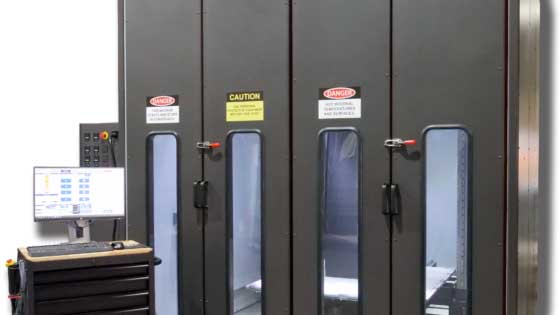
Titan Robotics is launching its largest industrial large-format 3D printing system, the Atlas 3.6. With a build volume of 50x50x72-in., the Atlas 3.6 is one of the largest production additive manufacturing systems on the market with sextrusion technology and an actively heated enclosure, enabling customers to print large parts out of high-performance materials including CF-PEI, GF-PEKK, nylons, ABS and more.
The Atlas 3.6 is designed to handle the additional weight and size of the machine, making it compatible with Titan’s Dual Pellet Extrusion and Hybrid Pellet + Filament Extrusion systems. Built with a heavy-duty, rigid design and components, the Atlas 3.6 can maintain accuracy and fast rapid travel speeds with the larger print area, the company says.
“When several of Titan’s industrial customers began requesting larger custom Atlas machines to meet their production needs, Titan began innovating to provide a robust solution to meet that need,” says Titan Robotics Partner Rahul Kasat. “With our team of engineers, manufacturing experts and our extensive experience in providing production additive manufacturing solutions, the development of the Atlas 3.6 further enables printing large parts at lower cost reliably using large-format industrial 3D printing. With this large build size, customers can now print large parts as is without worrying about slicing it in multiple sections for printing and trying to assemble it post-printing.”
Titan’s industrial customers are using the Atlas 3.6 across several industries, including aerospace and defense, consumer appliances, foundry and more. With an actively heated chamber reaching 80C and several extrusion configuration options, including Dual Pellet and Hybrid Pellet + Filament, the Atlas 3.6 provides solutions across a wide range of applications, from large-format tooling, patterns and molds, to functional parts, the company explains.
The Atlas 3.6 is immediately commercially available with extrusion configurations including Dual Pellet Extrusion, Hybrid Dual Pellet + Filament Extrusion, Hybrid Single Pellet + Filament Extrusion, and Single Pellet Extrusion. As a production additive manufacturing system, the Atlas 3.6 features an actively heated chamber, door safety interlocks and industrial CNC control system with closed loop servos on all axes.
Pellet extrusion on the Atlas enables production additive manufacturing solutions by printing directly with plastic pellets instead of traditional filament. Pellet extrusion increases throughput and decreases material costs, while also expanding the variety of materials that can be 3D printed.
Pellet Extrusion on the Atlas also enables the ability to print large, production parts due to the faster print speeds and higher throughput on the Atlas. Flow rates range from 1 lbs to 30 lbs per hour and prints speeds can top out at 30,000 mm per minute, reducing production time from days to hours.
The combination of reduced feedstock cost and faster print speeds provides reduced operational costs and faster cycle times with organic capacity.
Sources: Press materials received from the company and additional information gleaned from the company’s website.


DE's editors contribute news and new product announcements to Digital Engineering. Press releases may be sent to them via [email protected].
Follow DE






About Us · Contact Us · Editorial Team · Advertising · Privacy Policy · Subscriber Services · © 2026 Digital Engineering 24/7 · Peerless Media