Helping design and engineering professionals discover, evaluate and specify technologies and processes that shorten the design cycle and enable success.



May 2026 Special Focus: Artificial Intelligence in Design and Simulation
In this Special Focus Issue, learn about the latest developments in the integration of artificial intelligence into engineering workflows.

April 2026 Special Focus Issue: Generative Design
In this Special Focus Issue, Digital Engineering takes a look at how generative design solutions can be used across different types of design problems and with a variety of manufacturing approaches to accelerate design space exploration, and…
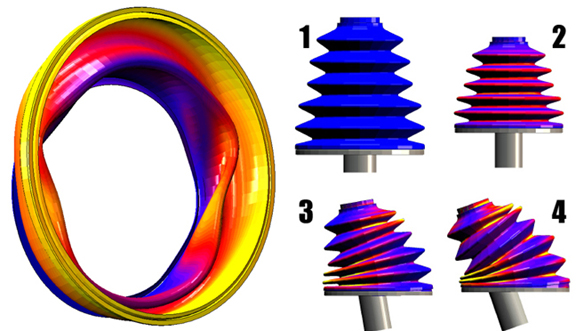
During the live Q&A session in my previous webinar with Autodesk's Amy Bunszel and PTC's Sandy Joung ("Materialistic Engineering: Building Stronger, Better Parts Using Interactive Tables and Equations," sponsored by Knovel), one caller raised the following question.
Is digital simulation good enough to replace physical tests?
To explore the topic further, I enlisted the help of Dr. Kim Parnell, founder and principal of PEC-Parnell Engineering & Consulting. (To hear webinar copresenters Amy and Sandy's responses to the same question, you can download the archived webinar.)
According to Dr. Parnell, "[Digital] simulation has definitely come a long way from its initial applications in linear, structural analysis. Today, complex nonlinear structural analysis is commonplace ... the other area where it has grown is in fluid dynamics."
On software-driven simulation's reliability, he noted, "If the question is, 'Can I totally replace physical testing [with digital simulation], and therefore do no physical testing and only do simulation?' I would say, in most cases, 'No.' But you can definitely reduce the amount of [physical] prototypes you build by the use of simulation ... Tests can be expensive. Prototypes may be very expensive. By reducing the number of prototypes you build and the number of tests you perform, you get a tremendous amount of benefit."
He also cautioned, "Simulation by itself is not enough. You need to do a certain amount of testing for understanding the variability, in geometry, materials, load, etc., and the environment in which the product is going to exist. The more high-value the product is, the more critical it is to life and safety, then the more you need to do beyond basic simulation." For more, listen to my recorded interview below:

About Kim Parnell
Dr. Parnell is an expert in the development and application of finite element analysis (FEA) techniques and the use of computational analysis to solve real-world problems. He has over 25 years of project experience involving critical engineering skills such as simulation, fracture/fatigue, reliability, life testing, FMEA, metallography, SEM inspection, failure analysis, forensic engineering, and root cause analysis with applications in fields including energy, medical devices, and vehicle crashworthiness. He can be reached via LinkedIN or PEC. Email at kim.parnell [at] stanfordalumni.org.
At the time of the interview, Dr. Parnell was senior manager in product management at MSC Software, an analysis software developer. Now, through his firm Parnell Engineering and Consulting (PEC), he continues to work with MSC Software and other clients as an independent consultant.


Kenneth Wong is Digital Engineering's resident blogger and senior editor. Email him at [email protected] or share your thoughts or suggestions at digitaleng.news/facebook.
Follow DE
Join over 90,000 engineering professionals who get fresh engineering news as soon as it is published.






About Us · Contact Us · Editorial Team · Advertising · Privacy Policy · Subscriber Services · © 2026 Digital Engineering 24/7 · Peerless Media