Helping design and engineering professionals discover, evaluate and specify technologies and processes that shorten the design cycle and enable success.



May 2026 Special Focus: Artificial Intelligence in Design and Simulation
In this Special Focus Issue, learn about the latest developments in the integration of artificial intelligence into engineering workflows.

April 2026 Special Focus Issue: Generative Design
In this Special Focus Issue, Digital Engineering takes a look at how generative design solutions can be used across different types of design problems and with a variety of manufacturing approaches to accelerate design space exploration, and…
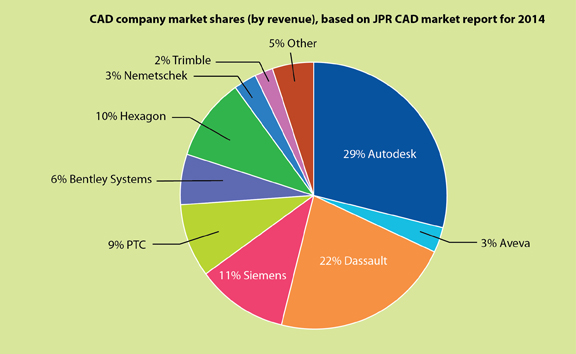
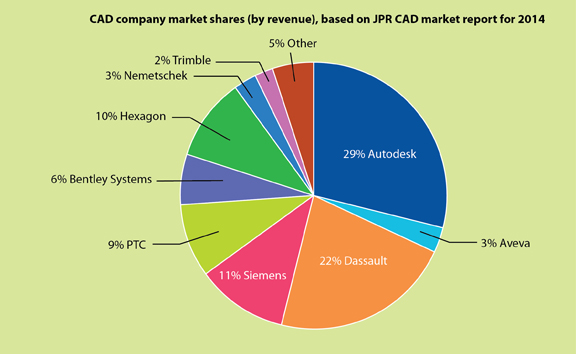 CAD company market shares (by revenue), based on data from JPR's 2014 CAD market report
Jon Peddie Research (JPR), a market watcher that tracks the design software market, has some good news. The CAD market is growing again -- to the tune of $8 billion in 2014.
The company writes, "Jon Peddie Research estimates the CAD software market to be an $8 billion market with 5.15 million annual users. We expect the market to grow to $8.7 billion in 2017 at a CAGR of 4%."
In JPR's market share breakdown, Autodesk leads the pack at 29%. The rest of the pie is divided by Dassault Systemes (22%), Siemens PLM Software (11%), and PTC (9%).
The landscape appears to be dominated by the usual suspects, but Kathleen Maher, VP and editor-in-chief of JPR's Tech Watch, said, "We are seeing the industry open up for new players and those new players are bringing new technologies with them. Most dramatically, of course, are the arrivals of Hexagon and Trimble, who are combining metrology with design and documentation to build location-aware CAD processes. Other companies helping change the face of CAD include SpaceClaim, which has been acquired by ANSYS; and GrabCAD, which has been acquired by Stratasys. I might even mention TechSoft, which has translation tools and 3D PDF publishing tools. It's been tough to shoehorn traditional CAD approaches into complementary market like simulation, analysis, 3D printing, visualization, etc. These companies are tackling those kinds of problems."
Some notable trends -- such as cloud computing, mobile devices, and virtualization -- don't necessarily "move the needle significantly for individual segments of CAD," according to Maher. But she added, "They are important technologies being incorporated into CAD vendors' business plans. Take mobile for instance, you'd be hard pressed to find a CAD vendor who does not have complementary tablet apps."
Maher also noticed a change in users' attitude, which is expected to pressure vendors to offer alternatives to desktop titles. "Just three years ago or so, the mantra in the CAD industry was, You'll see my data in the cloud when I'm cold and dead' (or, something like that)," she said. "That attitude has completely turned around, so while individuals and companies may not be rushing to use cloud-based workflows or virtualize their systems, there is a high degree of interest as evidenced by the shift in product offerings among CAD vendors."
JPR's look at the CAD industry encompasses products deployed in architecture and construction in addition to mechanical CAD. Maher observed, "The growth of CAD in regions is heavily influenced by the economic situation in certain regions. So, to put it simply, in those regions where the economy is booming, you'll find more manufacture, more construction, and therefore more use of CAD tools."
For more on the report, read JPR's summery here.


Kenneth Wong is Digital Engineering's resident blogger and senior editor. Email him at [email protected] or share your thoughts or suggestions at digitaleng.news/facebook.
Follow DE
Join over 90,000 engineering professionals who get fresh engineering news as soon as it is published.






About Us · Contact Us · Editorial Team · Advertising · Privacy Policy · Subscriber Services · © 2026 Digital Engineering 24/7 · Peerless Media