Helping design and engineering professionals discover, evaluate and specify technologies and processes that shorten the design cycle and enable success.


Alert!
Digital Engineering ceased publication on July 1, 2026. This website remains available as an archive of engineering content.
For inquiries or information, please email [email protected].

May 2026 Special Focus: Artificial Intelligence in Design and Simulation
In this Special Focus Issue, learn about the latest developments in the integration of artificial intelligence into engineering workflows.

April 2026 Special Focus Issue: Generative Design
In this Special Focus Issue, Digital Engineering takes a look at how generative design solutions can be used across different types of design problems and with a variety of manufacturing approaches to accelerate design space exploration, and…
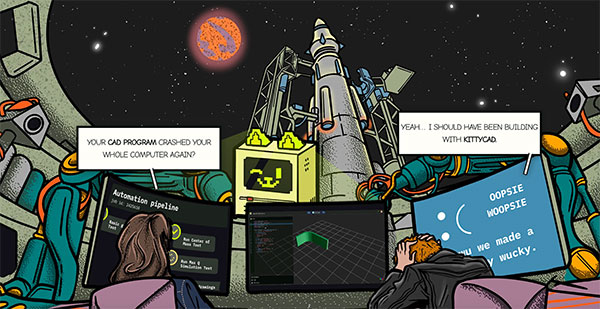
KittyCAD, a company that develops advanced tools for hardware design, has released geometry engine capabilities on its application programming interface. The KittyCAD API builds a bridge between hardware design, modern software and machine learning, allowing others to build on top of these capabilities and develop solutions for their own visions.
Launched in July 2022, KittyCAD’s API enables customers to develop fully integrated suites of hardware design products. In addition to KittyCAD’s API, the company develops open-source applications on top of its own API, which are used by customers as starting points for their own application development. Three of these open-source applications are being built in public by KittyCAD alongside the release of the API’s geometry engine capability: the KittyCAD Scripting Language (KCL), used to programmatically generate hardware designs, the KittyCAD Modeling App (KCMA), a graphical user interface for simultaneously interacting with hardware designs through code and visually in a single environment, and the KittyCAD diff viewer for visualizing differences in CAD files.
“KittyCAD allows modern software development to integrate with hardware design. Our API allows our customer’s software to talk to hardware designs, letting anyone develop hardware design tools on top of us that have never-before-seen capabilities.” says Jordan Noone, KittyCAD’s co-founder and executive chairman, who also led Relativity Space’s technical development as chief technical officer and co-founder for 5 years.
“We’ve seen the power of our own API by developing our own open source applications on top of it, and have surprised ourselves even with how quickly we can develop applications that could not exist before our API,” says Jessie Frazelle, KittyCAD’s co-founder and CEO, who was previously chief product officer at Oxide Computer Company and long-time infrastructure engineer.
Earlier this year, KittyCAD closed a $5M Series Seed financing led by Venrex Partners, a UK-based Venture Capital firm. The round also included participation from USC’s Viterbi School of Engineering, Gaingels, Kelvin Beachum, Matt Terrell, Undeterred Capital, Liquid 2, Tom Preston-Werner’s Family Office, Madrona Venture Group, Bernie Lagrange and Nat Friedman. The financing series will allow KittyCAD access to funds to continue hiring engineering talent to develop advanced hardware design tools and infrastructure.
Sources: Press materials received from the company and additional information gleaned from the company’s website.


DE's editors contribute news and new product announcements to Digital Engineering. Press releases may be sent to them via [email protected].
Follow DE






About Us · Contact Us · Editorial Team · Advertising · Privacy Policy · Subscriber Services · © 2026 Digital Engineering 24/7 · Peerless Media