Helping design and engineering professionals discover, evaluate and specify technologies and processes that shorten the design cycle and enable success.


Alert!
Digital Engineering ceased publication on July 1, 2026. This website remains available as an archive of engineering content.
For inquiries or information, please email [email protected].

May 2026 Special Focus: Artificial Intelligence in Design and Simulation
In this Special Focus Issue, learn about the latest developments in the integration of artificial intelligence into engineering workflows.

April 2026 Special Focus Issue: Generative Design
In this Special Focus Issue, Digital Engineering takes a look at how generative design solutions can be used across different types of design problems and with a variety of manufacturing approaches to accelerate design space exploration, and…
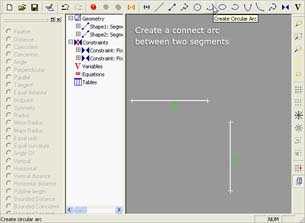 |
LEDAS Ltd. has announced version 4.0 of LGS 2D, its geometric constraint solver. It allows users to express design intent through geometric and dimensional constraints applied to elements of sketches and drawings.
Version 4.0 of LGS 2D introduces the following new functions: linear pattern constraints, directed distance constraints, and alignment/orientation attributes for most constraints.
Linear pattern constraints set relations between several sub-geometries of equal shapes (e.g. rectangles), aligning and uniformly distributing them along a given direction. Any changes in position or orientation of any one of the pattern constraint’s arguments leads to corresponding changes in other arguments. As with other LGS 2D constraints, a linear pattern constraint is variational, which means it can be combined with other constraints that are imposed on a pattern’s sub-geometries. All constraints are solved simultaneously.
Directed distance is a new constraint that generalizes horizontal and vertical distance constraints introduced in previous versions of LGS 2D. It is a ternary (three-element) constraint imposed on any pair of objects (points, circles, or curves) and a line that represents the direction of distance measurement. It can be used to prevent segments from flipping their end points; using a signed, directed distance constraint (instead of the ordinary distance) fixes the desired relative locations of the end points.
Alignment attributes specify whether the tangent vectors of the constraint arguments are co-directed (collinear vectors with positive scalar product) or counter-directed (collinear vectors with negative scalar product). The attribute can be applied to any constraint involving two non-point entities: tangency, distance, parallelism, or perpendicularity between lines, circles, curves or ellipses.
Orientation attributes control whether an argument is positioned to the left or right side of other ones. They are applied to all distance constraints, except point-point distances. Orientation and alignment attributes fully control the chirality (left or right handedness) of constraints.
All members of Open Design Alliance can use the LGS 2D integration module (developed jointly by LEDAS and the ODA) to implement constraint drawing functions that are compatible with the DWG file format.
For more information, visit LEDAS.
Sources: Press materials received from the company and additional information gleaned from the company's website.


DE's editors contribute news and new product announcements to Digital Engineering. Press releases may be sent to them via [email protected].
Follow DE






About Us · Contact Us · Editorial Team · Advertising · Privacy Policy · Subscriber Services · © 2026 Digital Engineering 24/7 · Peerless Media