Helping design and engineering professionals discover, evaluate and specify technologies and processes that shorten the design cycle and enable success.



Artificial Intelligence for Design and Engineering Workflows
In this white paper, learn how artificial intelligence and machine learning can improve design and simulation.

Technology Focus: Designing for Optimization & Simulation
Simulation is pervasive, with people from different departments and backgrounds discovering new ways to put it to use, in all of its varied forms.
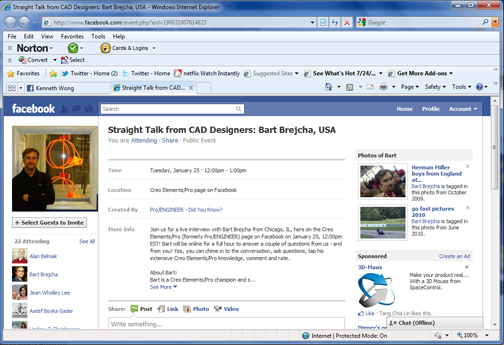
It's sort of like a live radio call-in show -- except for the fact that it's taking place on Facebook.
"Straight Talk from CAD Designers: Bart Brejcha," set for next Tuesday, Jan 25, at noon Eastern (9 AM Pacific), is a live discussion in social media. The event is organized by PTC, makers of Pro/ENGINEER, recently renamed Creo Elements/Pro.
At the event page (open to all Facebook users), the invitation reads, "Join us for a live interview with Bart Brejcha from Chicago, IL, here, on the Creo Elements/Pro (formerly Pro/ENGINEER) page on Facebook ... Bart will be online for a full hour to answer a couple of questions from us -- and from you! Yes, you can chime in to the conversation, ask questions, tap his extensive Creo Elements/Pro knowledge, comment and rate."
Bart's bio reads, "Bart is a Creo Elements/Pro champion and surfacing specialist. He is the principal instructor at Design Engine, primarily responsible for teaching the Creo Elements/Pro Surfacing, Cabling, Routed Systems Designer and Manufacturing classes, mainly the plastics part design and the die casting classes."
Ad hoc discussions about software and hardware take place on Facebook community walls all the time, but this may be one of the earliest live CAD/PLM discussions promoted and presented formally in social media. Of course, this is a paradox in itself, since discussions in social media are seldom "formal."
Here's how the organizer plans to deliver the event: The Page Admin (who will do what a moderator usually does in a live discussion) will introduce Bart with a kickoff comment. Then he/she will post about 10 questions for Bart to respond to. But if things get more active than anticipated -- in other words, if questions and comments from online attendees come in fast and furious -- the moderator will step back and let Bart fend for himself. (God help him!)
Like any other Facebook comments, you can "like" Bart's replies, or add your own two-cents to his answers. The rules also specify that "Nobody will be blamed for typos or wrong grammar." (If you do need tips on how to use the apostrophe correctly, don't contact Bart. Contact me. I'd be glad to go over what you missed in Miss Thistlebottom's class.)
Like its rival Dassault Systemes, PTC has begun looking at social media as an alternative to traditional project-management and data-management programs. The company develops and markets Windchill ProductPoint, as part of its push for "social product development," a social media-inspired approach to collaborative product development.
The upcoming "Straight Talk" Facebook discussion is a sign that PTC is willing to practice what it preaches.


Kenneth Wong is Digital Engineering's resident blogger and senior editor. Email him at [email protected] or share your thoughts or suggestions at digitaleng.news/facebook.
Follow DE
Join over 90,000 engineering professionals who get fresh engineering news as soon as it is published.






About Us · Contact Us · Editorial Team · Advertising · Privacy Policy · Subscriber Services · © 2026 Digital Engineering 24/7 · Peerless Media