Helping design and engineering professionals discover, evaluate and specify technologies and processes that shorten the design cycle and enable success.


Alert!
Digital Engineering ceased publication on July 1, 2026. This website remains available as an archive of engineering content.
For inquiries or information, please email [email protected].

May 2026 Special Focus: Artificial Intelligence in Design and Simulation
In this Special Focus Issue, learn about the latest developments in the integration of artificial intelligence into engineering workflows.

Design & Simulation Software Guide 2025
In this Special Issue, Digital Engineering presents its second annual guide to design and simulation software vendors.
For ECU timing analysis, Symtavision 4.0 includes a new data flow visualization capability in the SymTA/S toolset, which allows fast and easy analysis of the software and communication architecture, according to the company. With the help of interactive filters, the data flow graphs can be tuned to show the right level of abstraction enabling full exploration of system performance at the function architecture level.
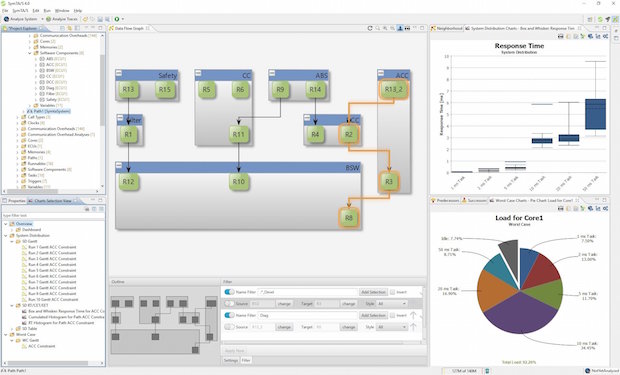 Symtavision 4.0 features new function-level analysis and ethernet network analysis upgrades.
Symtavision 4.0 also includes extensions to the ethernet network timing analyses in SymTA/S. Buffer occupancy in ethernet switches can now be undertaken at the buffer level, allowing the validation of switch memory and thereby reducing the risk of dropped frames due to buffer overflows. This is supported in simulation (system distribution) analysis and worst-case analysis. The addition of end-to-end jitter metrics provide an early hint as to the real-time capability of individual messages and helps to identify potential data losses at the receiver. Worst-case latency analysis has also been extended to cover ethernet AVB and support is now provided for AUTOSAR 4.2 ethernet models, including SOME/IP. For CAN networks, a new dashboard is available that provides a quick overview of the status of a network.
To support the automated testing of automotive ECUs and networks (CAN, FlexRay, Ethernet), both the SymTA/S TraceAnalyzer tools in Symtavision 4.0 offer advanced comparison of actual versus target behavior, facilitating fast verification of measurements against the expected behavior from the model. Additionally, the new activation pattern extraction feature allows quick modeling of non-periodic behavior, such as interrupt triggering or sporadic frames, from traces. Furthermore, the Symtavision 4.0 tool suite offers numerous usability improvements, including updated interfaces to trace tools such as Gliwa, iSYSTEM and Lauterbach, and copy-and-merge of elements between models, as well as performance improvements.
“Robust timing analysis of ECUs, networks and distributed systems becomes ever more crucial as the complexity of automotive electronics continues to grow," said Marek Jersak, director, Luxoft Automotive UTH Practice. “SymTA/S and TraceAnalyzer already have an enviable track record in the market and as the emphasis in timing design, analysis and verification of automotive electronics continues to shift towards increased driver assistance and the automated driving domains, we have continued to push the boundaries with the launch of Symtavision 4.0."
Visit Luxoft for more information.
Sources: Press materials received from the company.


DE's editors contribute news and new product announcements to Digital Engineering. Press releases may be sent to them via [email protected].
Follow DE






About Us · Contact Us · Editorial Team · Advertising · Privacy Policy · Subscriber Services · © 2026 Digital Engineering 24/7 · Peerless Media