Helping design and engineering professionals discover, evaluate and specify technologies and processes that shorten the design cycle and enable success.



Digital Engineering April 2026
In the latest issue of Digital Engineering, we take a look at the latest innovations in design for additive manufacturing, including the use of natural language inputs, social media cosplayers, and AI integration. The issue also includes a feature…

January Special Focus Issue: Design for Additive
In this Special Focus Issue of Digital Engineering, learn about the latest advancements in design for additive manufacturing, including new software tools, additive in automotive, custom medical devices, and more.
Mapal is a German company founded in 1950 that specializes in manufacturing machining solutions. If AM were living up to its disruptive description, Mapal would be either on the verge of extinction or facing some major internal adjustments. Instead of either of those scenarios, the company has embraced AM and developed its use to complement existing manufacturing methods.
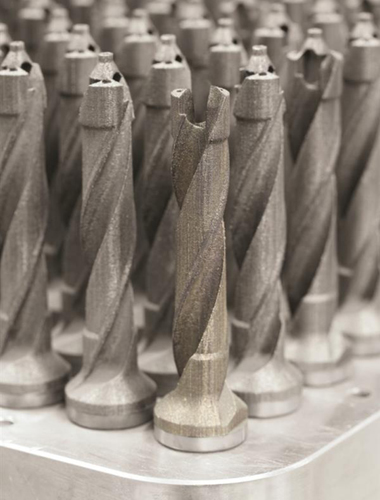 Built using metal AM, these drills run cooler than than their traditionally built predecessors. Courtesy of Mapal.
The first product to come from absorbing AM into manufacturing is the QTD-Series Insert Drills. The new series represents the company’s first hybrid product, with the tool shank manufactured through conventional machining, and the drill built using laser AM.
The result is an improved product that is not only less expensive to produce, but one that has expanded production options. Previously, the smallest QTD insert drill offered was 13mm. Smaller drills build up greater amounts of heat, and the previous design and manufacturing methods could not produce products capable of withstanding the heat. New AM insert drills have an improved cooling design that allows them to be produced in sizes starting at 8mm.
"The additively manufactured insert drill has a cooling concept with spiral ducts, which improves the cooling performance,” said Dirk Sellmer, head of testing and development at Mapal. “Compared with the previous central coolant supply with y diversion, a spiral coolant routing increases the coolant flow by 100%."
According to the press release, the new drills could only have been produced using AM.
“The cooling is also improved by the new coolant duct profiles which deviate from the usual circular form with a slightly triangular shape. That optimizes the geometrical moment of inertia and the flow rate. Tests found that choosing a cross section of this type increases the flow quantity by 30%. Coolant profiles like this cannot be produced conventionally. The coolant flows at a pressure of 1.6 to 3 bar.”
Production speed has been cited as one potential issue when switching from traditional manufacturing methods to AM. This doesn’t seem to be an issue when building the insert drills. Mapal chose a LaserCUSING system by Concept Laser for its production needs, and the build chamber is large enough to produce 100-121 drills in one build session.
Below you’ll find a demonstration of Concept Laser’s process in action.
Source: Industry News, Mapal


John Newman is a Digital Engineering contributor who focuses on 3D printing. Contact him via [email protected] and read his posts on Rapid Ready Technology.
Follow DE
Join over 90,000 engineering professionals who get fresh engineering news as soon as it is published.






About Us · Contact Us · Editorial Team · Advertising · Privacy Policy · Subscriber Services · © 2026 Digital Engineering 24/7 · Peerless Media