Helping design and engineering professionals discover, evaluate and specify technologies and processes that shorten the design cycle and enable success.



Digital Engineering April 2026
In the latest issue of Digital Engineering, we take a look at the latest innovations in design for additive manufacturing, including the use of natural language inputs, social media cosplayers, and AI integration. The issue also includes a feature…

January Special Focus Issue: Design for Additive
In this Special Focus Issue of Digital Engineering, learn about the latest advancements in design for additive manufacturing, including new software tools, additive in automotive, custom medical devices, and more.
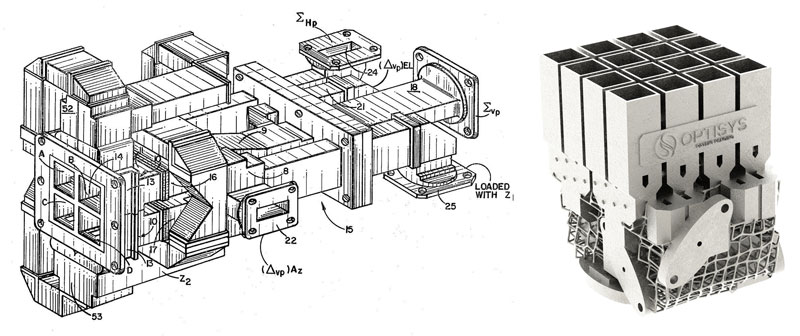 Optisys redesigned a large, multi-part antenna assembly (left) into a palm-sized, lighter, one-piece, 3D-printed metal antenna (right). The component was manufactured with a Concept Laser machine.
Antennas are critical for conveying information—voice, video and/or data—across long distances. They are widely employed in commercial and military aircraft, spacecraft, satellite communications, unmanned aerial vehicles (UAVs), and by ground terminals and land-based troops. Yet the complex radio frequency (RF) components that make up an antenna system can be large and heavy—characteristics that can impact mobility and performance.
“Companies in the commercial and military space are pressured for shorter lead-times, lighter weight and smaller antennas,” said Clinton Cathey, Optisys CEO in a press release. “By combining RF design simulation, mechanical engineering, and system optimization focused on AM, we provide metal 3D-printed antenna products at greatly reduced size, weight, lead-times, part count and cost—with as-good or better RF performance than conventionally manufactured systems. We’re creating structures that were simply not possible to produce in the past.”
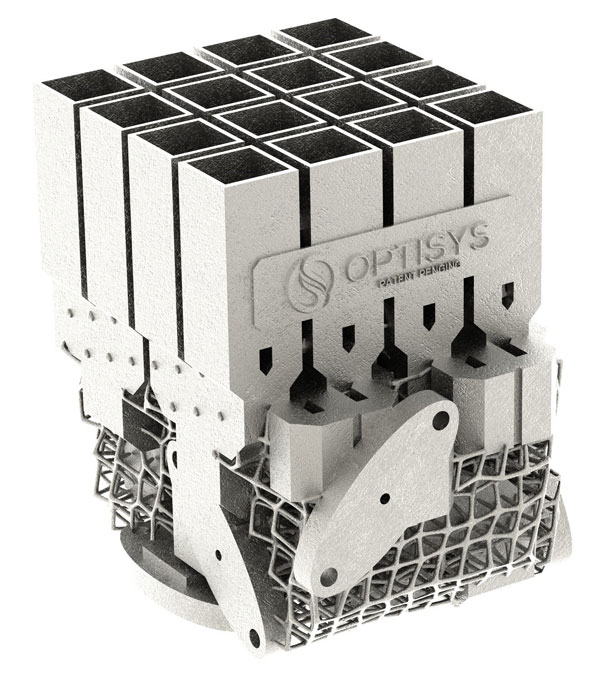
The test-piece demonstrator project involved a complete redesign of a high-bandwidth, directional tracking antenna array for aircraft (known as a Ka-band 4×4 Monopulse Array). Optisys performed every aspect of the design work in-house and printed the component in a single piece on their Concept Laser machine.
“Concept Laser’s powder-bed fusion in particular is perfect for this application because of the fine resolution it provides for antennas functioning in the one to one-hundred Gigahertz [GHz] range of RF in which most of our potential customers operate,” said Cathey via a press release.
Optisys conducted a profitability analysis on how their redesigned microwave antennae test piece compared to a legacy design that is traditionally manufactured. By optimizing their design for additive manufacturing, Optisys realized the following benefits:
Optisys can print in a variety of metals with its Concept Laser machine, though for antenna products they prefer aluminum because of its surface conductivity, light weight, corrosion resistance and strength under shock and vibration.
Part consolidation through AM provides a number of downstream benefits as well, Smith said, because it also reduces assembly and rework, makes it easier to add features to an existing AM design, and assemble the finished components. In the long-run, there is less testing, maintenance and service when you have fewer parts, he said.
For more information, visit Optisys and Concept Laser.


Join over 90,000 engineering professionals who get fresh engineering news as soon as it is published.






About Us · Contact Us · Editorial Team · Advertising · Privacy Policy · Subscriber Services · © 2026 Digital Engineering 24/7 · Peerless Media