Helping design and engineering professionals discover, evaluate and specify technologies and processes that shorten the design cycle and enable success.


Alert!
Digital Engineering ceased publication on July 1, 2026. This website remains available as an archive of engineering content.
For inquiries or information, please email [email protected].
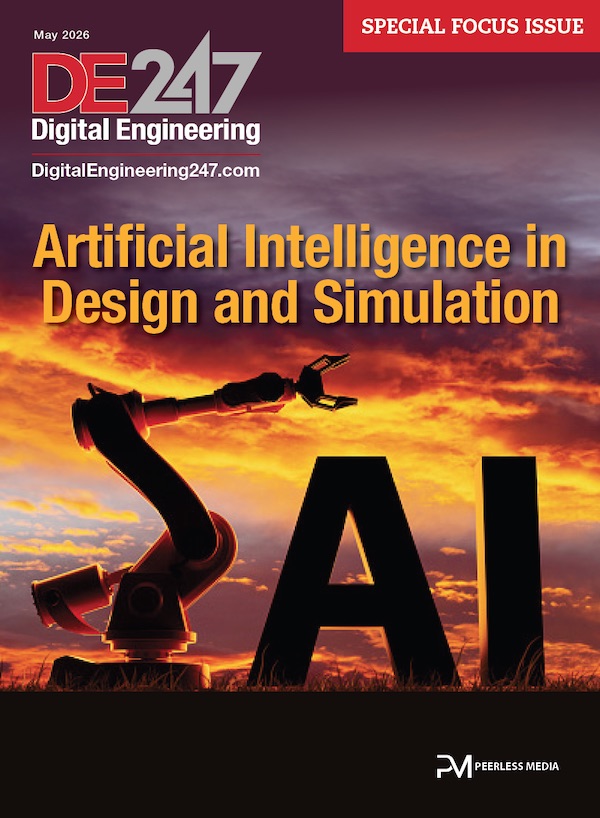
May 2026 Special Focus: Artificial Intelligence in Design and Simulation
In this Special Focus Issue, learn about the latest developments in the integration of artificial intelligence into engineering workflows.

Design & Simulation Software Guide 2025
In this Special Issue, Digital Engineering presents its second annual guide to design and simulation software vendors.
MSC Software Corporation, simulation software and services provider, announced the new release of Marc 2018 focused to further improve specific industry workflows, particularly for rubber and seal modeling. Additionally, the release provides advancements in contact analysis, multiphysics simulations, convergence control, solver interoperability, all tuned in for efficiency and quality.
Following are some highlights of the release.
Marc 2018 provides coupled simulation techniques to calculate the resulting temperatures and study the self-heating behavior of viscoelastic materials under cyclic loading. The process makes it easy to capture the interaction of thermal and harmonic effects and examine "what if" scenarios.
The company introduces an additional damage model called Ogden-Roxburgh that provides engineers with another efficient and accurate method to predict the degradation process of rubbers that undergo cyclic loading. The new damage model has more flexibility in experimental data fitting.
Marc and Mentat 2018 provide an automated contact detection method that enables engineers to quickly generate or modify contact tables based on the proximity of Meshed Bodies. This capability can improve productivity by providing the ability to adjust the model without spending several hours.
Marc 2018 can now use faceted (STL) surfaces directly in a contact analysis. Using this method can improve the fidelity and quality of contact definition as the solver internally uses smooth surface algorithms for rigid contact bodies.
As a multidisciplinary software, Marc 2018 provides advancements for multiphysics simulations to include symmetric and anti-symmetric boundary conditions through both coupled and sequential analyses. Some applications include optimization of gear teeth hardening through induction heating process.
Marc 2018 has a new convergence check that verifies equilibrium on a per node basis. The forces resulting from internal elements, contacts and external loads are monitored for each node and compared to a user defined convergence tolerance: epsilon. The secondary convergence check is designed to reduce the amount of increments and improve the accuracy of results.
Use the software to accurately predict the real-world behavior of rubber materials, easily manage analysis of multi-level assemblies, and address induction heating problems, all in a fully comprehensive and efficient workflow, the company reports.
Sources: Press materials received from the company.


MSC Software develops simulation software technology that enables engineers to validate and optimize their designs using virtual prototypes. Customers in almost every part of manufacturing use our software to complement, and in some cases even…

ePowertrain by Design
Electrification is the single largest disruptor that has occurred to mobility in decades and in particular it is impacting the automotive industry faster and more widely than other sectors.

DE's editors contribute news and new product announcements to Digital Engineering. Press releases may be sent to them via [email protected].
Follow DE
Join over 90,000 engineering professionals who get fresh engineering news as soon as it is published.






About Us · Contact Us · Editorial Team · Advertising · Privacy Policy · Subscriber Services · © 2026 Digital Engineering 24/7 · Peerless Media