Helping design and engineering professionals discover, evaluate and specify technologies and processes that shorten the design cycle and enable success.


Alert!
Digital Engineering ceased publication on July 1, 2026. This website remains available as an archive of engineering content.
For inquiries or information, please email [email protected].

Digital Engineering April 2026
In the latest issue of Digital Engineering, we take a look at the latest innovations in design for additive manufacturing, including the use of natural language inputs, social media cosplayers, and AI integration. The issue also includes a feature…

January Special Focus Issue: Design for Additive
In this Special Focus Issue of Digital Engineering, learn about the latest advancements in design for additive manufacturing, including new software tools, additive in automotive, custom medical devices, and more.
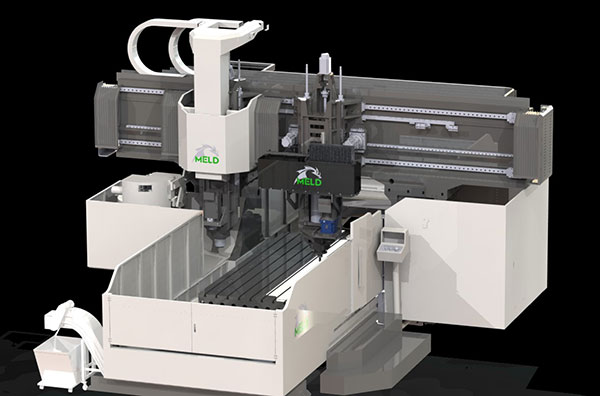
MELD debuted its newest machine, 3PO, at Formnext 2022 in Frankfurt am Main, Germany. It features a MELD additive system with an integrated subtractive head independent of the additive portion. It has a large amount of cubic build space while eliminating the need for a separate subtractive machine, according to the company.
3PO, named after Star Wars droids like the other MELD printers, has a print capacity of 157.5x106.0x39.4-in. (4,000x2,700x1.000 mm) with a print volume of 380 ft3 (10.8m3). It offers continuous printing capability for large-scale parts.
The subtractive capabilities include a standard three-axis head, with an optional five-axis head. With a maximum travel speed of 475 inches/minute (12 m/minute) parts can be in service quickly and efficiently.
The MELD process is a no-melt, open atmosphere technology capable of printing large metal parts. It yields isotropic, fully dense parts with low residual stresses. Because it is a no-melt process even un-weldable metals can be printed. MELD parts can be printed in hours or days.
The MELD technology is suited to address several challenges facing the defense sector along with other industries:
“In response to customer demand, we’ve increased the size of parts possible with MELD, and added subtractive functionally to machine in features throughout the build,” states CEO Nanci Hardwick.
Though 3PO is the first MELD commercial off the shelf hybrid machine, it’s not the first machine that MELD has been involved in that includes subtractive capabilities. The MELD technology is being deployed in a machine for the U.S. Army’s Jointless Hull Program. This metal printer incorporates additive and subtractive capabilities with a print volume of 20x30x12-ft. (6.1x9.1x3.7 m).
Sources: Press materials received from the company and additional information gleaned from the company’s website.


DE's editors contribute news and new product announcements to Digital Engineering. Press releases may be sent to them via [email protected].
Follow DE
Join over 90,000 engineering professionals who get fresh engineering news as soon as it is published.






About Us · Contact Us · Editorial Team · Advertising · Privacy Policy · Subscriber Services · © 2026 Digital Engineering 24/7 · Peerless Media