Helping design and engineering professionals discover, evaluate and specify technologies and processes that shorten the design cycle and enable success.


Alert!
Digital Engineering ceased publication on July 1, 2026. This website remains available as an archive of engineering content.
For inquiries or information, please email [email protected].
Sponsored
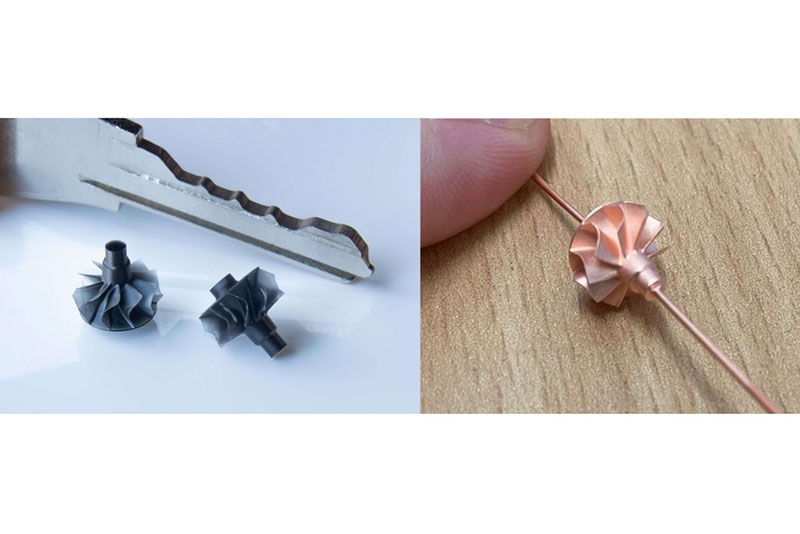

Digital Engineering April 2026
In the latest issue of Digital Engineering, we take a look at the latest innovations in design for additive manufacturing, including the use of natural language inputs, social media cosplayers, and AI integration. The issue also includes a feature…

January Special Focus Issue: Design for Additive
In this Special Focus Issue of Digital Engineering, learn about the latest advancements in design for additive manufacturing, including new software tools, additive in automotive, custom medical devices, and more.
Micro 3D printing and metal plating are complementary technologies that can produce low-cost parts for applications that require metal surfaces and/or electrical conductivity. Because plastics typically cost less than metals, metal-clad plastics can reduce material expenses; however, 3D printed polymers are often a poor choice for plating because of their surface finish. Moreover, most 3D printers cannot produce intricate parts with high precision. Among the 3D printers that can, the degree of precision may be more than the application requires.
To produce plastic parts with fine features such as holes, slots, and cavities, micro injection molding or CNC machining can be used prior to plating. Micro injection molding is not cost-effective across low volumes, however, and even low-volume precision machining can be cost-prohibitive because specialized labor and expensive production processes are required. Per-unit costs decrease across higher volumes, but precision CNC machining has some other drawbacks. By comparison, micro 3D printing and metal plating is a promising option for parts that cost less and have the required precision.
PµSL 3D Printing and Metal Plating
Capable of achieving resolution of 2µm~50µm and tolerances of +/- 5µm~25µm, Boston Micro Fabrication’s microArch series of micro-precision 3D printers are the perfect 3D printing technology to metal plate, creating smooth, glass-like surface finishes not capable on most other 3D printing systems. 3D printed parts created with BMF’s Projection Micro Stereolithography (PµSL) technology can be plated with copper or nickel in different percentages to achieve specific mechanical, functional, or aesthetic properties. This includes EMI/RFI shielding and cladding that is designed to increase abrasion, solvent, flame, or temperature resistance. This presents a low-cost, easily repeatable alternative for production of small and complex metal components that are expensive to make with traditional manufacturing methods.
BMF works with a metal plating specialist in the United Kingdom that has optimized the cladding of PµSL parts. 3DDC, the U.K. electroplating and 3D printing company, has performed proof-of-concept tests and can apply lessons learned about solvent washes, additional dry time for off-gassing, and ultraviolet (UV) and/or thermal post-curing. Service provider expertise is significant because plating highlights substrate imperfections. A recent BMF test with 3DDC demonstrates the value that PµSL 3D printing and metal plating provides. It also suggests future applications.
Achieving Proof-of-Concept
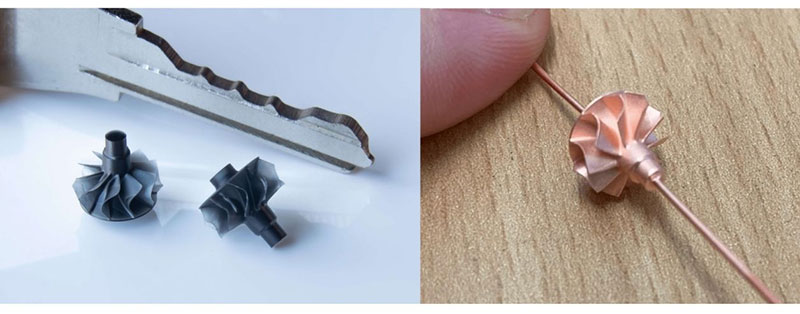
The experiment involved cladding an (80 µm) micro turbine that was produced using a PµSL 3D printer. The micro turbine’s geometry was challenging and the fan blades were smaller than most plastic parts that are plated. This successful test used UV post-curing and thermal curing at 50° C (122° F) for one hour. The micro turbine was coated first with 1 µm electroless nickel and then with 5 µm of electroplated copper. Because the amount of metal used was small, the material savings from PµSL was significant compared to an all-metal micro turbine. Expensive CNC machining was eliminated, too.
Importantly, because the micro turbine in this experiment has the required dielectric properties, potential applications for PµSL 3D printing and metal plating include high-frequency waveguides with small, precise features. Traditionally, waveguides have been machined from metal and, to achieve small features, required precision operations. Consequently, BMF’s experiment with 3DDC represented an important proof-of-concept for Birmingham University and Flann Microwave, two organizations that would like to produce cost-effective waveguides for microwave and millimeter-wave applications. Additional applications could include 4G and 5G antennas, devices with small channel sizes.
To learn more about PμSL or to discuss a potential application for metal-clad PµSL parts, contact us.


Boston Micro Fabrication is the world leader in micro-precision 3D printers utilizing Projection Micro Stereolithography (PµSL) technology. Many leading companies worldwide are adopting PµSL to 3D print true microstructures with ultra-high…

Ultra-high Accuracy, Precision, and Resolution Micro 3D Printed Medical Device Manufacturing
Discover how the use of micro-precision 3D printing is aiding medical device producers to tackle two common issues through this white paper.

Join over 90,000 engineering professionals who get fresh engineering news as soon as it is published.






About Us · Contact Us · Editorial Team · Advertising · Privacy Policy · Subscriber Services · © 2026 Digital Engineering 24/7 · Peerless Media