Helping design and engineering professionals discover, evaluate and specify technologies and processes that shorten the design cycle and enable success.


Alert!
Digital Engineering ceased publication on July 1, 2026. This website remains available as an archive of engineering content.
For inquiries or information, please email [email protected].


Digital Engineering April 2026
In the latest issue of Digital Engineering, we take a look at the latest innovations in design for additive manufacturing, including the use of natural language inputs, social media cosplayers, and AI integration. The issue also includes a feature…

January Special Focus Issue: Design for Additive
In this Special Focus Issue of Digital Engineering, learn about the latest advancements in design for additive manufacturing, including new software tools, additive in automotive, custom medical devices, and more.
Building and advancing the additive manufacturing (AM) ecosystem drove discussions at this year’s America Makes 12th annual Members Meeting & Exchange (MMX) event, August 6-7 at Waypoint 4180 in Canfield (near Youngstown). The event is curated by and for stakeholders in the U.S. AM sector.
John Wilczynski, executive director, opened with the America Makes State of the Union, addressing approximately 360 guests who represented about 220 firms across the U.S. AM industry, academia, government and military.
He noted how America Makes is vested in growing the AM “ecosystem,” defined as an effort to grow awareness and adoption of AM across the U.S. through collaboration with regional, state, and national groups.
“Additive manufacturing is maturing to a point where there is a need for an ecosystem,” Wilczinski says. “We [at America Makes] have spent so much time focused on technology development. While [tech] developments are important, when we started to build the conversation around how businesses are making money or are they making money, or what do they need to do to make money, it all started to get a lot more real. These [discussions] are something we have to embrace, even if painful at times.
“We really have to mature and increase the knowledge base for the community so that we’re able to use [AM] in the right spots and so that ideally we make money at it,” he added. “It’s not because we can’t do it, but it may be because someone doesn’t even know it’s possible or how to do it.”
“There’s still tremendous amount of work to do in our industry,” Wilczynski continued. “We have built a roadmap [for additive manufacturing’s future] but ultimately we’re in the position now where we are taking action in the roadmap.”
The first keynote on the future of additive manufacturing was led by seasoned additive manufacturing expert, Terry Wohlers, head of advisory services and market intelligence, Wohlers Associates (powered by ASTM International). He highlighted AM applications and trends, developments in materials and emerging business opportunities.
Before his presentation, Wohlers says he toyed with ChatGPT, asking “how to forecast the future.” It spit out several points:
“Analyze past data to identify patterns.”
“Have a network of experts.”
“Create narratives that lead to possible scenarios.”
“Leverage large datasets.”
“Acknowledge uncertainties.”
And lastly, “review and update.”
Specific to AM’s future outlook, Wohlers said, “Based on the data we collect year after year—thousands of data points—one thing we know: We want functionality of the parts we’re building. We don’t want only show-and-tell type parts. We want real, rigorous functional parts. The data confirms that.”
Wohlers fully expects “applications will drive the growth of the industry,” attributing his observation to words of wisdom he gleaned from a known industry leader some years back.
"When Fried Vancraen, founder and former CEO of Materialise, stated the role applications would play in AM’s growth years ago, he got my attention. I have given it a great deal of thought and examination over the past few years and found his thinking to be spot on. While systems and materials play a role, it’s the application of them that make a difference and contribute to industry growth. Without applications, we would not have an industry."
Noting the most popular processes to watch: Wohlers mentions powder bed fusion of polymers and metals, followed by material extrusion and vat photopolymerization. "We believe the popularity of these processes will continue in the foreseeable future. Directed energy deposition and binder jetting are beginning to gain traction, but they have a lot of catching up to do," he says.
Despite the industry's areas with growth potential, the AM industry is not without its challenges. "Driving down the cost of machines and materials for series production applications is one of the top challenges," Wohlers says. "As this occurs—and it will—the number of applications will expand, especially for series, custom, and limited-edition products. Qualification and certification challenges continue to slow the adoption of AM in some sectors, such as aerospace and healthcare, even though they were among the earliest to use the technology for very serious production applications."
Threaded throughout the first-day sessions were discussions surrounding the structuring of an AM ecosystem, other keynotes on advanced materials in the Department of Defense (DoD), and the need for convergent manufacturing, a workforce development panel on strategies to align education and workforce development, and a panel of perspectives on the AM supply chain.
In the keynote on advanced materials, Aisha Haynes, Ph.D., principal director for advanced materials, OUSD(R&E), S&T Futures, asked the audience: Why is there a need for new and advanced materials?
“Simply put, materials are the backbone for every item that we provide the warfighter. As we look ahead, it’s clear that new challenges will arise that can only be met by pushing boundaries of what’s possible with advanced materials,” Haynes suggests.
She explained that the character of modern warfare has fundamentally changed
“Battlespace that is not just connected but also a space that is highly contested, transparent and dynamic. Advanced materials will be crucial in how we sense, control, protect, survive and ultimately win in the evolving battle space,” she says.
In a later panel discussion on supply chains, moderator Kimberly Gibson, ecosystem director at America Makes, invited a handful of experts on stage to share perspectives on next-generation AM supply chains.
Michelle Meyer, founder & CEO of Matter Providers, revealed the key to AM-enabled supply chains. “As additive continues to scale the technologies and application of it into manufacturing, these supply chains are going to be different from the traditional industrial supply chains. With distributed manufacturing—the nature and applications of it and how we support it—new materials and technologies are going to create new supply chains.”
This type of supply chain, as Meyer explains, is greenfield (a type of supply chain planning still in its beginning stages). “Because it’s greenfield, the ecosystem will have the need to help invest in that. The ecosystem will be investment in people and partners. In order to scale the technology, we have to scale the ecosystem.”
Moderator Gibson asked the panel how to avoid over-investing in a technology and “watching it get frittered away.”
Dayton Horvath, director of emerging technologies for Association for Manufacturing Technologies, chimed in “There is not just one solution. Working as an investment banker on the sell side for 3D printing companies, for advanced materials and advanced manufacturing companies more broadly, if you don’t have incentives aligned between shareholders or stakeholders or customers in management, you’re going to be fighting to prioritize profitability.
“The more I’ve worked with bootstrap type companies,” Horvath continued, “I learned it really came down to are we incentivized by the compensation structures and by the way this company is expected to grow? And is it expected to grow in a sustainable manner?”
He said the focus is on how to support small/medium companies in growing sustainably. “What we’ve seen with the falling from grace after a very, very hot capital market cycle in 2021 and 2022 is that additive markets have fallen precipitously and we’re trying to figure out where is the sustainable growth that we’re trying to feed into.”
Also during the event, the Joint Defense Manufacturing Council recommended that the strategic collaboration established between the U.S. Department of Defense and America Makes should remain in place. John Wilczynski and Robyn Vialva, government program manager at the U.S. Air Force Research Laboratory, announced the recommendation.
Additionally, about a dozen exhibitors, including Lithoz, Juggerbot, Nano Dimension and Xact Metal, as well as some native Youngstown area organizations, were on hand at the event.
As for industries maximizing use of AM in the future, Wohlers noted how while medical, dental and aerospace have been early adopters of AM for manufacturing for production quantities, followed by government, military, power/energy, the biggest current user for all applications and for the foreseeable future is automotive, though not by a big margin, according to Wohlers.
“Automotive will drive costs downward as automotive companies scale up,” he says.
Wohlers shared an example of the new 2024 Cadillac sporting a 3D printed steering wheel. The car itself contains 115 different 3D printed aluminum, stainless steel and polymer parts. Processes are multijet fusion (polymer process), metal binder jetting and powder bed fusion.
He also touched on mergers and acquisitions in the AM space. "M&A is inevitable in a growing and maturing industry. Many of the AM-related acquisitions of the past, especially those in the 2009–2015 timeframe, were not good for the industry. Most of the more than 50 companies acquired had strong IP, good commercial ideas, and energy, but the lion’s share of it was sadly buried by the buyers. The situation today is quite different. Maturing companies with aging founders are considering an exit and are often a good match for larger companies looking for IP, new business opportunities, and market share."
In closing, Wohlers noted, “Development of materials and systems will absolutely move the needle. Detailed data can really show you lots of interesting trends. For applications of AM, like Fried said, automation will definitely drive growth. Carbon footprint impact is getting more attention. Keep an eye on China—they are not sitting still. There’s an optimistic future for AM.”


As the national accelerator for additive manufacturing (AM) and 3D printing (3DP), America Makes is the nation’s leading and collaborative partner in AM and 3DP technology research, discovery, creation, and innovation. Structured as a…
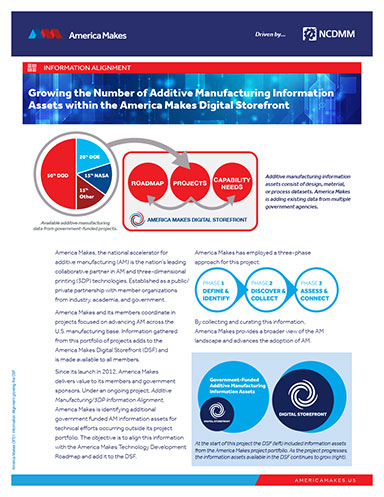
Additive Manufacturing/3DP Information Alignment
Growing the number of additive manufacturing information assets within the America Makes digital storefront.

Stephanie is the Associate Editor of Digital Engineering.
Follow DE






About Us · Contact Us · Editorial Team · Advertising · Privacy Policy · Subscriber Services · © 2026 Digital Engineering 24/7 · Peerless Media