Helping design and engineering professionals discover, evaluate and specify technologies and processes that shorten the design cycle and enable success.


Alert!
Digital Engineering ceased publication on July 1, 2026. This website remains available as an archive of engineering content.
For inquiries or information, please email [email protected].

Digital Engineering April 2026
In the latest issue of Digital Engineering, we take a look at the latest innovations in design for additive manufacturing, including the use of natural language inputs, social media cosplayers, and AI integration. The issue also includes a feature…

January Special Focus Issue: Design for Additive
In this Special Focus Issue of Digital Engineering, learn about the latest advancements in design for additive manufacturing, including new software tools, additive in automotive, custom medical devices, and more.
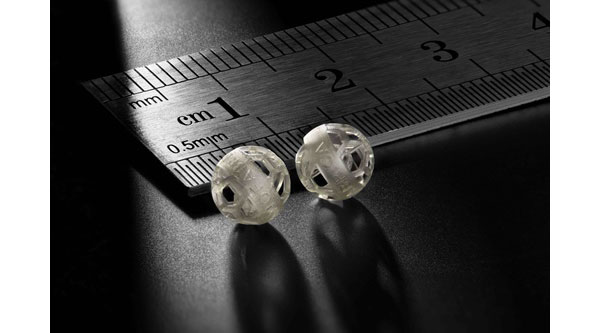
Nano Dimension Ltd. announces that its additive manufacturing (AM) group has expanded its micro-additive manufacturing (Micro-AM) product line with a broader range of systems, the company reports. The company has recently announced an expanded AM product line with a new range of Fabrica Micro-AM solutions with several additional systems known as the Tera 25, the Giga 250, and the Giga 25.
“Nano Dimension is responding to an exponential interest from industry, and our Fabrica range of Micro-AM solutions have been developed as compelling solutions for industries seeking precise and efficient micro manufacturing processes," says Ziki Peled, president EMEA at Nano Dimension. "With the ability to create intricate structures and components on a micron scale, micro AM offers unparalleled design freedom and complexity, enabling the production of highly customized and optimized parts.
"This technology minimizes material waste and reduces the need for assembly by fabricating complex geometries in a single build, leading to improved overall efficiency," Peled adds. "Industries such as electronics, medical devices, aerospace, and automotive are finding immense value in Micro-AM which is poised to play a pivotal role in driving innovation, cost-effectiveness, and competitiveness across various sectors in today’s rapidly evolving industrial landscape.”
The key difference between the Tera and Giga machines is the build volume, with the smaller Giga machines aimed at prototyping applications and the larger Tera machines aimed at higher volume production. The Tera 250 and the Tera 25 have a build volume of 50x50x100 mm, while the Giga 250 has a build volume of 6x9x45 mm and the Giga 25 a build volume of 12x18x45 mm.
Both the Tera and Giga machines are capable of micron-level resolution.
“We have developed the Giga series of machines so our customers can cost-effectively benefit from micro-AM’s transformative approach to precision part and component prototyping, which surpass traditional methods in several crucial aspects," says Peled. "Unlike conventional prototyping, Micro-AM enables the direct creation of intricate and complex geometries without the constraints of subtractive manufacturing processes. This not only expedites the design iteration process but also allows for the production of prototypes that accurately represent the final product’s intended form and function."
The Giga 25 and Tera 25 machines exhibit optical resolution of 8 microns, tolerance accuracy of 5 microns, and achieve 0.9 micron surface roughness (Ra), and the Giga 250 and Tera 250 exhibit optical resolution of 2 microns, tolerance accuracy of 2 microns, and achieve 0.4 micro surface roughness (Ra).
“The range of build volumes, optical resolution, tolerance, and surface roughness capabilities we offer through the Giga and Tera machines caters for a full range of customer prototyping and production requirements," Peled concludes.
Sources: Press materials received from the company and additional information gleaned from the company’s website.


DE's editors contribute news and new product announcements to Digital Engineering. Press releases may be sent to them via [email protected].
Follow DE






About Us · Contact Us · Editorial Team · Advertising · Privacy Policy · Subscriber Services · © 2026 Digital Engineering 24/7 · Peerless Media