Helping design and engineering professionals discover, evaluate and specify technologies and processes that shorten the design cycle and enable success.


Alert!
Digital Engineering ceased publication on July 1, 2026. This website remains available as an archive of engineering content.
For inquiries or information, please email [email protected].

Digital Engineering April 2026
In the latest issue of Digital Engineering, we take a look at the latest innovations in design for additive manufacturing, including the use of natural language inputs, social media cosplayers, and AI integration. The issue also includes a feature…

January Special Focus Issue: Design for Additive
In this Special Focus Issue of Digital Engineering, learn about the latest advancements in design for additive manufacturing, including new software tools, additive in automotive, custom medical devices, and more.
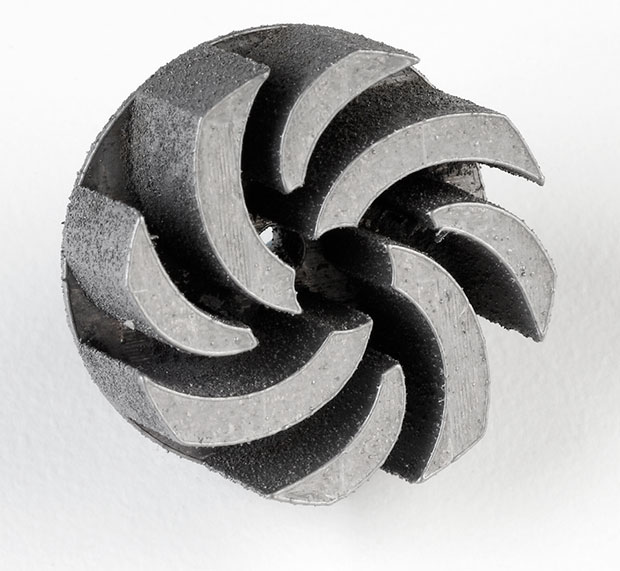 This NanoSteel impeller was produced with laser powder bed fusion. The company's new additive manufacturing materials give manufacturers flexibility to meet part-performance requirements. Image courtesy of NanoSteel Co.
Last year, NanoSteel developed AM wear materials that could help print with the laser powder bed fusion process. The parts that this technique created were fully dense, crack free and had hardness levels of less than 1000 HV.
The new gradient materials, according the company, offer the equivalent of "digital case hardening." This provides impact resistance, overall robustness and gives OEMs (original equipment manufacturers) design flexibility to meet part-performance requirements.
“Proprietary metal alloys that support the cost-effective 3D printing of high-quality parts will help accelerate the transition from subtractive to additive manufacturing across applications such as wear parts, bearings, and cutting tools,” said Harald Lemke, general manager of Engineered Powders, NanoSteel. “The company’s AM powder offerings make it possible to design exclusively for the function of a high hardness part, releasing designers from the limitations of conventional production processes and opening new opportunities to improve performance.”
For more information, visit NanoSteel.
Sources: Press materials received from the company and additional information gleaned from the company’s website.


DE's editors contribute news and new product announcements to Digital Engineering. Press releases may be sent to them via [email protected].
Follow DE






About Us · Contact Us · Editorial Team · Advertising · Privacy Policy · Subscriber Services · © 2026 Digital Engineering 24/7 · Peerless Media