Helping design and engineering professionals discover, evaluate and specify technologies and processes that shorten the design cycle and enable success.



Digital Engineering April 2026
In the latest issue of Digital Engineering, we take a look at the latest innovations in design for additive manufacturing, including the use of natural language inputs, social media cosplayers, and AI integration. The issue also includes a feature…

January Special Focus Issue: Design for Additive
In this Special Focus Issue of Digital Engineering, learn about the latest advancements in design for additive manufacturing, including new software tools, additive in automotive, custom medical devices, and more.
NASA, already an early adopter of AM, is now ready to back bioprinting with a $100,000 grant. Unlike other forms of bioprinting, the project being backed would eventually be able to print nearly anything by pulling the ingredients from thin air.
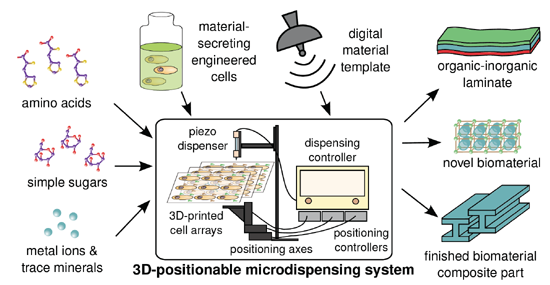
Imagine being able to print anything from tools and composite building materials to food and human tissues. Imagine being on Mars with the ability to replace any broken part, whether it's a part of your spacesuit, your habitat, or your own body. We propose a technique that would allow just that. By printing 3D arrays of cells engineered to secrete the necessary materials, the abundant in situ resources of atmosphere and regolith become organic, inorganic, or organic-inorganic composite materials. Such materials include novel, biologically derived materials not previously possible to fabricate. –Lynn Rothschild
The process is envisioned working by gathering sunlight and CO2 by way of algae collectors to provide energy. Raw materials are gathered as well, in the most basic forms possible, forming the building blocks of printed objects. These materials are then built up in standard AM fashion into engineered cells which, in turn, build the object required.
Any benefits to the space program would certainly trickle down to civilian industries, possibly bringing about new breakthroughs in medical bioprinting. The process could also be used to build miniaturized organs for testing — replacing the use of animals — for the creation of bioengineered implants, and biofilms for testing new medicines.
Below you’ll find a video about NASA’s more traditional use of AM to build a rocket engine fuel injector.


John Newman is a Digital Engineering contributor who focuses on 3D printing. Contact him via [email protected] and read his posts on Rapid Ready Technology.
Follow DE
Join over 90,000 engineering professionals who get fresh engineering news as soon as it is published.






About Us · Contact Us · Editorial Team · Advertising · Privacy Policy · Subscriber Services · © 2026 Digital Engineering 24/7 · Peerless Media