Helping design and engineering professionals discover, evaluate and specify technologies and processes that shorten the design cycle and enable success.


Alert!
Digital Engineering ceased publication on July 1, 2026. This website remains available as an archive of engineering content.
For inquiries or information, please email [email protected].

May 2026 Special Focus: Artificial Intelligence in Design and Simulation
In this Special Focus Issue, learn about the latest developments in the integration of artificial intelligence into engineering workflows.

Design & Simulation Software Guide 2025
In this Special Issue, Digital Engineering presents its second annual guide to design and simulation software vendors.
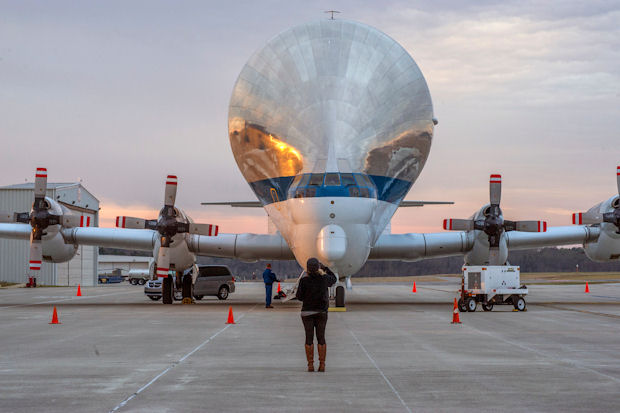 NASA’s Super Guppy airplane lands at the Redstone Army Airfield near Huntsville, AL, on March 26. Image courtesy of NASA/MSFC/Emmett Given.
On March 26, 2014, a wide-bodied Super Guppy aircraft from NASA landed at the Redstone Army Airfield near Huntsville, AL, with a special passenger. When the aircraft’s hinged nose opened, a cryogenic fuel tank measuring 18 ft. in diameter emerged. The cargo was in transit, destined for a series of tests at NASA’s Marshall Space Flight Center nearby. Though it’s intended to fuel space missions, the tank was built by The Boeing Co., a manufacturer more closely associated with air travel.
Boeing, known around the world for its jetliners, also happens to be the prime contractor for designing, developing and manufacturing NASA launch vehicle components. The company’s Space Launch System (SLS) division attests to its aspiration to be a major player in the space exploration business. In 2011, NASA awarded Boeing a $24 million contract to develop and manufacture two cryogenic fuel tanks. The delivery in March marked the first of the two. It was manufactured in Boeing’s Developmental Center in Tukwila, WA. What distinguishes this tank from the others is the construction materials -- composites.
The project was part of the space agency’s efforts to identify new technologies for future missions. For its part, Boeing relies on software-based simulation -- conducted in products such as MSC Patran and Nastran -- to test and refine the tank’s design.
Michael Gazarik, NASA’s director of the space technology program, spelled out the objectives. “The goal of this particular technology demonstration effort is to achieve a 30% weight savings and a 25% cost savings from traditional metallic tanks,” he said. John Vickers, project manager at NASA’s Marshall Space Flight Center, described the project as “one of the largest composite propellant tanks ever built.”
Dan Rivera, Boeing’s program manager, said, “To design the tank, we use new materials. We process the tank by automated fiber placement. The benefit of that is, we can lay down the material quickly, which provides a low-cost operation and a lightweight tank.”
To accomplish the ambitious weight reduction goal, engineers turned to software-driven optimization. In a paper titled “Cryogenic Tank Structure Sizing with Structural Optimization Method,” NASA authors wrote: “Structural optimization methods in MSC Nastran are used to size substructures and to reduce the weight of a composite sandwich cryogenic tank for future launch vehicles … In this study, a simple procedure is introduced to create a new starting point based on design variable values from previous optimization analyses. Optimization analysis using this new starting point can produce a lower weight design.”
MSC Software products can simulate and optimize composite ply layup, analyze laminate stresses and strains and identify potential failures. According to MSC, they’re widely used in designing aircraft panels, floors, doors, heat shields, wing structures, rudder, helicopter fuselage, rotor blades and ballistic protection.
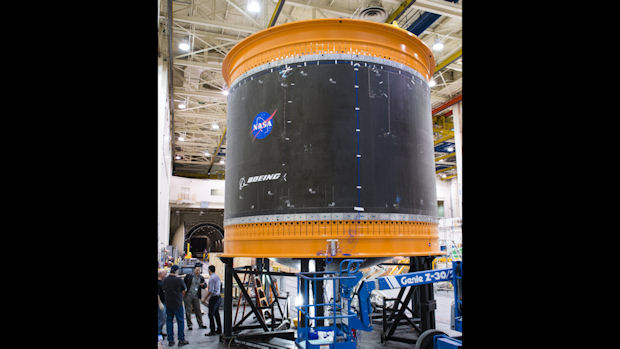 One of the largest composite rocket propellant tanks ever manufactured is prepared for transport on NASA’s Super Guppy airplane. Image courtesy of The Boeing Co.
“In this project, solid elements were used to model the critical joints in the composite tank,” says Hanson Chang, an MSC Software application engineer who helped Boeing engineers build the Nastran finite element models. “Solid elements simulating composite layers allow the engineers to assess the peel stress and interlaminar shear stress in the composite layup under mechanical and cryogenic loading environments.”
With composites, the orientation of the materials -- specifically, the layout and direction of the plies -- also affect the durability, strength and shearing behavior of the products built. To design the cryogenic fuel tank, Boeing used a mix of solid and shell elements to get the best results.
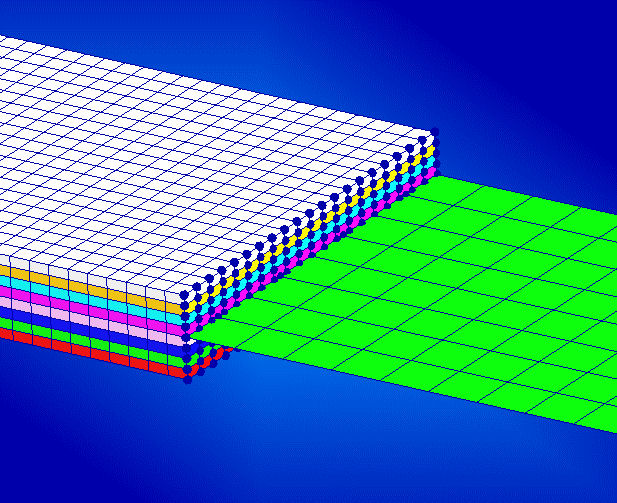 An MSC Software interface shows glued contact between solid elements and shell elements with the contact footprint (blue spheres) plotted. Image courtesy of MSC Software.
“In areas away from the critical joints, shell composite elements were used instead of solid elements to minimize the model size,” Hanson said. “The shell composite element edges are connected to solid element faces using the glued contact technology in MSC Nastran. Additional techniques such as modeling only a slice of the tank by applying axisymmetric boundary conditions were also used. These modeling techniques helped to reduce the model size so design trade studies could be performed quickly to explore different tank joint configurations.”
Because space travel is associated with weightlessness, it may sound paradoxical to hear about NASA’s desire to use composites to reduce weight in its launch vehicles. But weight has a direct impact on the volume of fuel required in space travel. “The Space Technology Mission Director pushes us to develop technologies that make NASA missions more affordable, more capable, and more reliable,” NASA’s Vickers said.
Boeing’s Rivera remarked, “Being able to prove that we can design and build and contain liquid hydrogen only using composite is a significant breakthrough.”
In October 2014, Vickers and Rivera headed out to Orlando for the Composites and Advanced Materials Expo (CAMX). During the conference, in a ballroom inside the Orange County Convention Center, just an hour’s drive west from Cape Canaveral at the Kennedy Space Center, Vickers and Rivera accepted the Combined Strength Award for Composites Excellence for the Composite Cryogenic Technology Demonstration.
“This is one of NASA’s major technology accomplishments for 2014,” said Gazarik. “This is the type of technology that can improve competitiveness for the entire U.S. launch industry, not to mention other industries that want to replace heavy metal components with lightweight composites. These tests, and others we have conducted this year on landing technologies for Mars vehicles, show how technology development is the key to driving exploration.”


Kenneth Wong is Digital Engineering's resident blogger and senior editor. Email him at [email protected] or share your thoughts or suggestions at digitaleng.news/facebook.
Follow DE






About Us · Contact Us · Editorial Team · Advertising · Privacy Policy · Subscriber Services · © 2026 Digital Engineering 24/7 · Peerless Media