Helping design and engineering professionals discover, evaluate and specify technologies and processes that shorten the design cycle and enable success.



Digital Engineering April 2026
In the latest issue of Digital Engineering, we take a look at the latest innovations in design for additive manufacturing, including the use of natural language inputs, social media cosplayers, and AI integration. The issue also includes a feature…

January Special Focus Issue: Design for Additive
In this Special Focus Issue of Digital Engineering, learn about the latest advancements in design for additive manufacturing, including new software tools, additive in automotive, custom medical devices, and more.
One of the potential advantages of 3D printing is the ability to create repair parts on the fly. If a part is unavailable or difficult to obtain, users could reverse engineer a replacement and print it on site. The U.S. military has been researching this concept as a possible way to allow deployed troops, for example, to create repair parts in the field.
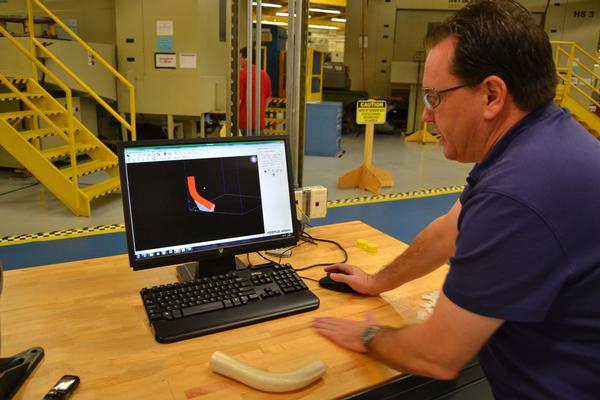 Randy Meeker, an Fleet Readiness Center Southeast tooling designer, displays the duct for a T-44 Pegasus that was printed in the facility's manufacturing department. Image: U.S. Navy photo by Clifford Davis
Engineers at the Navy’s Fleet Readiness Center Southeast (FRCSE) in Jacksonville, FL, recently leveraged 3D printing to solve a similar supply problem. The FRCSE has printed a piece of air duct tubing for an aircraft cooling system.
“This is an awesome milestone for our facility,” said FRCSE Commanding Officer Capt. Chuck Stuart. “It shows the innovative approaches our artisans and engineers incorporate to help support the U.S. military every day.”
The FRCSE has been using 3D printers since 2014 to create prototypes and print parts for support equipment. The air duct tubing is the first printed piece to be used in an actual aircraft.
The part was printed in response to the original manufacturer of the T-44 Pegasus running out of the air duct piece. Originally, the team considered creating a vacuum form of the original tube, but tooling maker Randy Meeker suggested printing the piece.
Meeker and his team created the replacement tube using Ultem 1085 composite material, and improved the design by turning the two-piece component into a single component.
“There is a lot of responsibility on the engineer for these parts that are actually used in aircraft,” Meeker said. “It’s a whole new world of technology, and it’s their responsibility to make sure it can be used safely. That’s why this particular project was a good first candidate because it’s not a flight-critical part, but it’s a step forward in incorporating 3-D printed parts into aircraft.”
Source: Naval Air System Command


Brian Albright is the editorial director of Digital Engineering.
Contact him at [email protected].

Join over 90,000 engineering professionals who get fresh engineering news as soon as it is published.






About Us · Contact Us · Editorial Team · Advertising · Privacy Policy · Subscriber Services · © 2026 Digital Engineering 24/7 · Peerless Media