Helping design and engineering professionals discover, evaluate and specify technologies and processes that shorten the design cycle and enable success.



Digital Engineering April 2026
In the latest issue of Digital Engineering, we take a look at the latest innovations in design for additive manufacturing, including the use of natural language inputs, social media cosplayers, and AI integration. The issue also includes a feature…

January Special Focus Issue: Design for Additive
In this Special Focus Issue of Digital Engineering, learn about the latest advancements in design for additive manufacturing, including new software tools, additive in automotive, custom medical devices, and more.
One of those new applications is a new blood recycling machine developed by Brightwake. Based in Nottinghamshire, UK, Brightwake is a “… creative development, engineering, production and research company specializing in the development of innovative solutions for all kinds of manufacturing, operational and logistical problems.” In this case, the creative development is called Hemosep and it was built in part using a Stratasys Dimension 1200es.
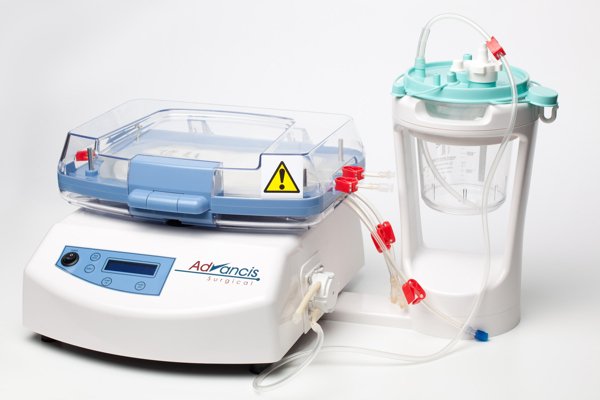
The Hemosep recovers blood lost during major operations and concentrates the blood cells prior to transfusion back to the patient in a process known as autotransfusion. The prototype machine (which has won a patent) uses a number of 3D printed parts, including the main filtration and cooling systems.
“The Hemosep consists of a bag that uses chemical sponge technology and a mechanical agitator to concentrate blood sucked from a surgical site or drained from a heart-lung machine after surgery,” said Steve Cotton, Brightwake’s director of research and development. “The cells are then returned to the patient via blood transfusion. In a climate of blood shortage, this recycling methodology has the potential to be a game-changer within the medical industry, saving the National Health Service millions.”
The new machine underwent successful trials in Turkey where it assisted in over 100 open-heart surgeries. One of the first patients to reap the benefits of the Hemosep in the UK was a female heart patient who, because of her religious beliefs, asked not to receive any donated blood. The Hemosep was able to return enough of the patient’s blood to maintain both her life and her religious ideals.
Use of AM to develop the new machine offered significant cost and time savings.
“Previously we had to outsource the production of these parts which took around three weeks per part,” said Cotton. “Now we’re 3D printing superior strength parts overnight, cutting our prototyping costs by 96% and saving more than £1,000 for each 3D printed model. 3D printing has not only enabled us to cut our own costs, it has also been crucial in actually getting a functional device to clinical trials. The ability to 3D print parts that look, feel and perform like the final product, on-the-fly, is the future of medical device manufacturing.”
Below you’ll find a video about the Hemosep.
Source: Stratasys


John Newman is a Digital Engineering contributor who focuses on 3D printing. Contact him via [email protected] and read his posts on Rapid Ready Technology.
Follow DE
Join over 90,000 engineering professionals who get fresh engineering news as soon as it is published.






About Us · Contact Us · Editorial Team · Advertising · Privacy Policy · Subscriber Services · © 2026 Digital Engineering 24/7 · Peerless Media