Helping design and engineering professionals discover, evaluate and specify technologies and processes that shorten the design cycle and enable success.




Digital Engineering April 2026
In the latest issue of Digital Engineering, we take a look at the latest innovations in design for additive manufacturing, including the use of natural language inputs, social media cosplayers, and AI integration. The issue also includes a feature…

January Special Focus Issue: Design for Additive
In this Special Focus Issue of Digital Engineering, learn about the latest advancements in design for additive manufacturing, including new software tools, additive in automotive, custom medical devices, and more.
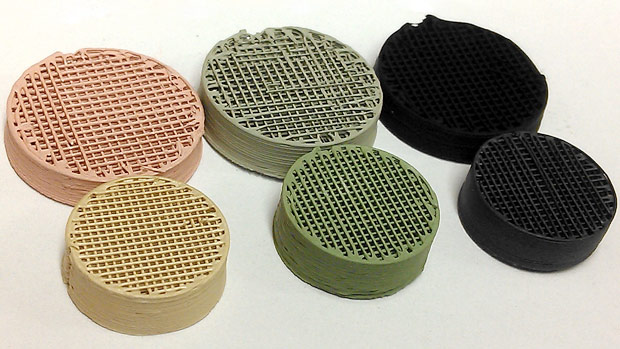 Researchers have developed special inks to print solid oxide ceramic fuel cells. Image: Northwestern University
The new inks can create the individual components of the solid oxide fuel cell, and are a mixture of ceramic particles, a binder, and a variety of solvents that evaporate at different rates.
As the machine prints, a volatile solvent in the ink evaporates immediately, speeding the transition from liquid to solid. The other solvents in the ink evaporate later, so that the printed piece is soft enough to meld with the next line. While the printing is done at room temperature, the finished piece has to be fired under high temperatures. The researchers have developed a process of adjusting the composition of the various inks so that each part of the fuel cell shrink at the same rate during firing.
The team was led by Ramille Shah, assistant professor of materials science and engineering at Northwestern, via the Shaw Group Tissue Engineering and Additive Manufacturing (TEAM) lab.
The Shah TEAM discussed their work at the Materials Research Society's Fall Meeting & Exhibit earlier in December. According to the presentation abstract:
Unlike other non-elastomeric binding materials used in powder-based fabrication, the rapid precipitation of elastomer from the solvents upon extrusion results in densification of the surrounding powder, producing solid fibers that may be continuously deposited. Lower volatility solvents remain within the deposited strands and permit immediately adjacent layers and fibers to seamlessly fuse together over the course of minutes. This ultimately results in monolithic, high fidelity (sub 100 µm feature size) objects that can be physically handled immediately after printing.
By printing the cells in one piece, manufacturers can reduce complexity and cost. The cells could also potentially be created in new shapes that increase surface area and improve transport of charge.
Source: Materials Research Society


Brian Albright is the editorial director of Digital Engineering.
Contact him at [email protected].

Join over 90,000 engineering professionals who get fresh engineering news as soon as it is published.






About Us · Contact Us · Editorial Team · Advertising · Privacy Policy · Subscriber Services · © 2026 Digital Engineering 24/7 · Peerless Media