Helping design and engineering professionals discover, evaluate and specify technologies and processes that shorten the design cycle and enable success.



Digital Engineering April 2026
In the latest issue of Digital Engineering, we take a look at the latest innovations in design for additive manufacturing, including the use of natural language inputs, social media cosplayers, and AI integration. The issue also includes a feature…

January Special Focus Issue: Design for Additive
In this Special Focus Issue of Digital Engineering, learn about the latest advancements in design for additive manufacturing, including new software tools, additive in automotive, custom medical devices, and more.
Regardless of results, the common lament about metal AM is that of 3D printing in general. In a word, it’s slow. No matter how powerful, a laser or binding agent can only trace patterns in a bed of powdered metal so quickly and still produce solid parts. Northwestern University (NU) may have solved the problem by removing the powder bed completely.
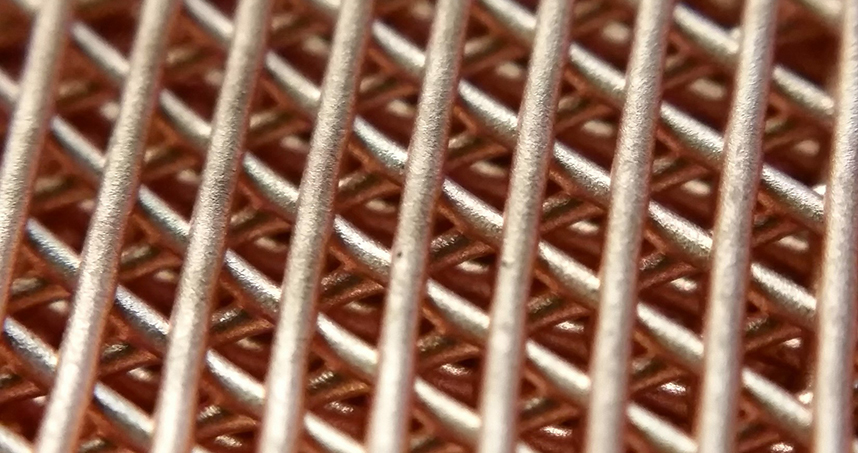 Copper lattice constructed using Northwestern's new method of metal AM. Courtesy of Northwestern University.
Researchers at NU’s McCormick School of Engineering have developed a system of AM that uses metal powder suspended in a mix of solvents and an elastomer binder to produce metallic ink. The ink can be used at room temperature and squeezed through an extruder head to build objects one layer at a time in basically the same manner as plastic 3D printers. Finished objects, or “greens,” are then sintered together in a furnace, producing a solid part.
“This is exciting because most advanced manufacturing methods being used for metallic printing are limited as far as which metals and alloys can be printed and what types of architecture can be created,” said Ramille Shah, assistant professor of materials science and engineering in the McCormick School of Engineering, who led the study. “Our method greatly expands the architectures and metals we’re able to print, which really opens the door for a lot of different applications.”
It might seem as though the two-step process would be slower than simply sintering the objects in a powder bed, but NU researchers claim that isn’t the case.
“By uncoupling the printing and the sintering, it appears that we have complicated the process,” said collaborator David Dunand, the James N. and Margie M. Krebs Professor of Materials Science and Engineering. “But, in fact, it has liberated us as each step is much easier separately than the combined approach.”
NU’s process doesn’t require metal to be melted at any point of the build, which opens up new material options. Standard metal printing processes are limited in what metals are available because of melting points. The new process is capable of handling many materials, including rust.
The team’s research can be found in the journal Advanced Functional Materials with the title “Metallic Architectures from 3D-Printed Powder-Based Liquid Inks.” Below you’ll find a video about the standard method of building metal parts.
Source: NU


John Newman is a Digital Engineering contributor who focuses on 3D printing. Contact him via [email protected] and read his posts on Rapid Ready Technology.
Follow DE
Join over 90,000 engineering professionals who get fresh engineering news as soon as it is published.






About Us · Contact Us · Editorial Team · Advertising · Privacy Policy · Subscriber Services · © 2026 Digital Engineering 24/7 · Peerless Media