Helping design and engineering professionals discover, evaluate and specify technologies and processes that shorten the design cycle and enable success.


Alert!
Digital Engineering ceased publication on July 1, 2026. This website remains available as an archive of engineering content.
For inquiries or information, please email [email protected].

May 2026 Special Focus: Artificial Intelligence in Design and Simulation
In this Special Focus Issue, learn about the latest developments in the integration of artificial intelligence into engineering workflows.

April 2026 Special Focus Issue: Generative Design
In this Special Focus Issue, Digital Engineering takes a look at how generative design solutions can be used across different types of design problems and with a variety of manufacturing approaches to accelerate design space exploration, and…
nTopology has released its third-generation latticing technology, an advanced lattice generation tool available.
The new latticing tools, according to the company, are easy to use, faster than previous generation offerings, and offer greater control over complex lattice structures. They also provide the basic infrastructure for the features coming up next.
The new latticing technology release includes 37 blocks that have been in development. The updates implement feedback from the nTop community, and prepare documentation for the transition.
The goal was to make it as easy as possible for new nTop users to access the new latticing tools from the moment they start using the software.
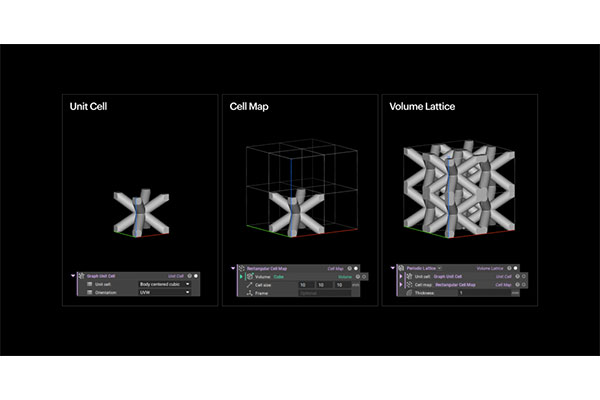
The company separated the lattice generation processes into three fundamental steps: select a unit cell, define the cell map and control lattice parameters (such as thickness).
Mastering these steps makes it faster and more intuitive to learn how to apply advanced latticing and design for additive manufacturing techniques later.
For existing nTop users, the goal was to make the transition to the new latticing technology streamlined.
In the updated Lattices tab, there are three new easy-to-use blocks that enable users to quickly replicate the outputs of workflows using the old latticing technology. Use these blocks to transition existing workflows to the new latticing technology at your own pace.
When transitioning your workflows to the new latticing technology, you may notice a performance increase, especially when working with lattices with a high beam and unit cell count.
In one benchmark example, a lattice with 50,000+ unit cells used to take 45-60 seconds to generate on a well-equipped laptop. Now, it rebuilds in 1-2 seconds.
Sources: Press materials received from the company and additional information gleaned from the company’s website.


DE's editors contribute news and new product announcements to Digital Engineering. Press releases may be sent to them via [email protected].
Follow DE
Join over 90,000 engineering professionals who get fresh engineering news as soon as it is published.






About Us · Contact Us · Editorial Team · Advertising · Privacy Policy · Subscriber Services · © 2026 Digital Engineering 24/7 · Peerless Media