Helping design and engineering professionals discover, evaluate and specify technologies and processes that shorten the design cycle and enable success.


Alert!
Digital Engineering ceased publication on July 1, 2026. This website remains available as an archive of engineering content.
For inquiries or information, please email [email protected].

Digital Engineering April 2026
In the latest issue of Digital Engineering, we take a look at the latest innovations in design for additive manufacturing, including the use of natural language inputs, social media cosplayers, and AI integration. The issue also includes a feature…

January Special Focus Issue: Design for Additive
In this Special Focus Issue of Digital Engineering, learn about the latest advancements in design for additive manufacturing, including new software tools, additive in automotive, custom medical devices, and more.
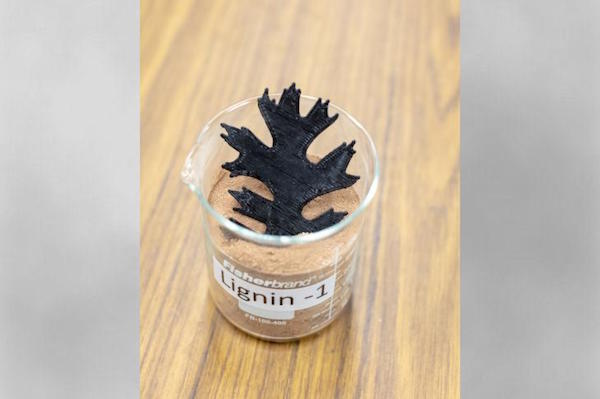
Researchers at Oak Ridge National Laboratory (ORNL) have made more progress in their effort to create a renewable 3D printing material using the biomass byproduct called lignin.
Lignin is a byproduct of the biofuel manufacturing process. It’s a polymer found in most plants. While it can be burned to generate power in a biorefinery, those facilities produce so much lignin that it still creates a significant waste stream. ORNL first published research on its lignin work in Applied Materials Today last year.
“Finding new uses for lignin can improve the economics of the entire biorefining process,” said ORNL project lead Amit Naskar.
The research (“A path for lignin valorization via additive manufacturing of high-performance sustainable composites with enhanced 3D printability”) was recently published in the journal Science Advances.
The ORNL team combined hardwood lignin with low-melting nylon and carbon fiber to create a new type of composite that can be used in 3D printing.
Lignin can only be heated up to a certain temperature for extrusion before it chars. If it gets too hot for too long, it is too thick for a print nozzle. Combining lignin with nylon increased the material’s room temperature stiffness and reduced its melt viscosity. This gave it a tensile strength similar to nylon, but with a lower viscosity than ABS or polylstyrene.
According to ORNL, the resultant material can heat more easily, flow faster and provides greater strength in the printed item.
“ORNL’s world-class capabilities in materials characterization and synthesis are essential to the challenge of transforming byproducts like lignin into coproducts, generating potential new revenue streams for industry and creating novel renewable composites for advanced manufacturing,” said Moe Khaleel, associate laboratory director for Energy and Environmental Sciences.
Source: ORNL


Brian Albright is the editorial director of Digital Engineering.
Contact him at [email protected].






About Us · Contact Us · Editorial Team · Advertising · Privacy Policy · Subscriber Services · © 2026 Digital Engineering 24/7 · Peerless Media