Helping design and engineering professionals discover, evaluate and specify technologies and processes that shorten the design cycle and enable success.



Cut Retrieval-Augmented Generation (RAG) Hallucinations by 50%
Most teams hit the same wall with enterprise AI: LLMs that hallucinate, pipelines that don’t scale, and infrastructure that’s harder to design than the models themselves.

What Is Intelligent BOM Management? A Guide to Smarter Product Development
Learn how intelligent Bill of Materials (BOM) management helps teams collaborate, reduce errors, and bring innovative products to market faster with cloud-based PLM tools.
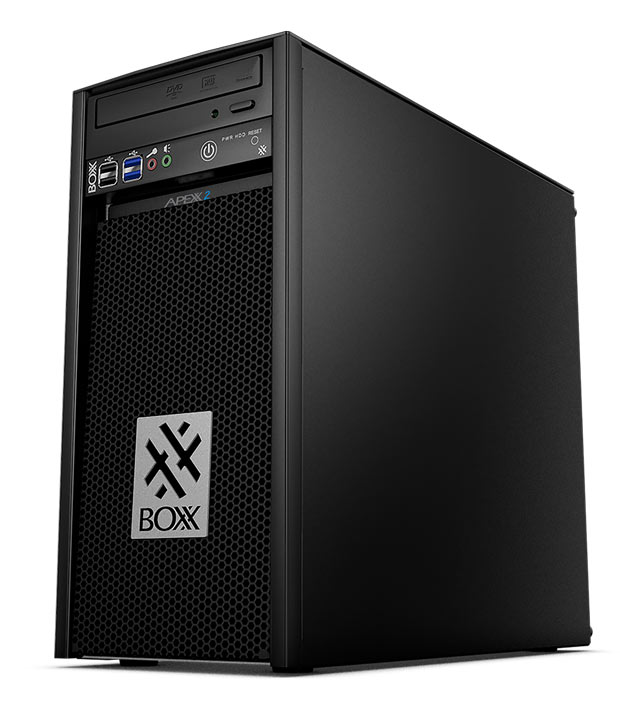 Ideal for professionals with CAD design and 3D modeling workflows, the compact BOXX APEXX 2 2402 workstation features a quad-core Intel 6th Generation Core i7 processor overclocked to 4.4GHz. Image courtesy of BOXX Technologies.
The APEXX 2 2402 workstation features a quad-core Intel 6th Generation Core i7 “Skylake” processor overclocked to 4.4GHz. Its compact, black aluminum chassis measures 6.85x14.6x16.6 in. (WxHxD; 17.4x45.7x51.3 cm) and offers room for two x16 NVIDIA GeForce, Quadro, Tesla or AMD FirePro graphics cards. Its maximum system memory capacity is 64GB.
To keep operations both cool and quiet, the APEXX 2 2402 deploys with a liquid cooling system that is derived from the same technology designed for mission-critical data centers, says BOXX. The company adds that by providing optimal management of the processor’s heat output, the liquid cooling technology ensures long-term stability and performance.
Connection and expansion features of the APEXX 2 2402 include two front panel audio ports as well as two USB 2.0 and two USB 3.0 ports. Rear panel ports include four additional USB 3.0 ports, two USB 3.1 (one each of Type A and Type C ports) and gigabit networking, audio, HDMI, DVI and other port connectors. The workstation also has four 2.5-in. internal drive bays, two 2.5-in. internal drive bays and one external 5.25-in. drive bay.
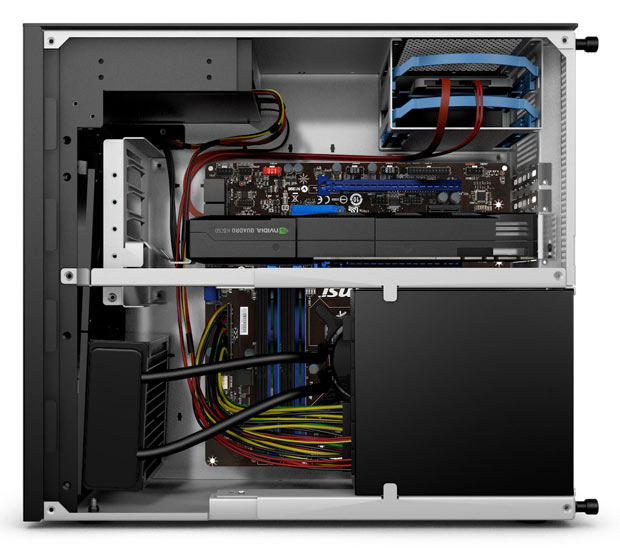 An interior view of a BOXX APEXX 2 workstation. Image courtesy of BOXX Technologies.
A recommended configuration of the APEXX 2 2402 comes with a four-core Intel Core i7 processor overclocked to 4.4GHz, 16GB of DDR4-2133 memory, a 2GB NVIDIA Quadro K620 graphics accelerator, 256GB of SSD (solid-state drive) M.2 storage, a 20x dual-layer optical drive, keyboard, mouse and 64-bit Windows 7 or 8.1 Professional Edition. Pricing begins at $2997.
The Linux operating system, additional storage and display options are among the options available. For complex details on the BOXX APEXX 2 2402 workstation, visit BOXX Technologies.
Download the APEXX 2 2402 spec sheet.
Read DE Contributing Editor David Cohn's review of the APPEXX 2 2402’s predecessor.
Read the BOXX Blog on the new APEXX 2 2402 workstation.
See why DE's editors selected the BOXX APPEXX 2 2402 workstation as their Pick of the Week.
Sources: Press materials received from the company and additional information gleaned from the company's website.


Anthony J. Lockwood is Digital Engineering's founding editor. He is now retired. Contact him via [email protected].
Follow DE
Join over 90,000 engineering professionals who get fresh engineering news as soon as it is published.






About Us · Contact Us · Editorial Team · Advertising · Privacy Policy · Subscriber Services · © 2026 Digital Engineering 24/7 · Peerless Media