Helping design and engineering professionals discover, evaluate and specify technologies and processes that shorten the design cycle and enable success.


Sponsored
 Dear Desktop Engineering Reader:
Today's Check it Out offering is about hardware, software and all the activities that go on behind the curtain of technology while you're busy being an engineer. We're talking parallelization – a.k.a. parallel processing, and this is a small paper you'll get big things from.
It's safe to say that parallel processing has revolutionized the way your engineering software operates and your expectations of what you can do. Still, what is parallelization? How can design engineers leverage it better? Are there limits to what parallel processing can do? Where's its future heading?
The “Parallelization Primer,” chapter 3 of “The Design Engineer’s High-Performance Computing Handbook” from DE and Intel, has answers to questions like that. This is not a programming manual. It's a guide that'll provide you with sufficient data so that you know what's going on with parallel processing and how it affects your work.
Chapter 3 defines parallelization as technology that directs a computer's many functions like a maestro conducts an orchestra. Parallel processing describes your large simulation problems as small pieces of work, then solves each piece using multiple processors or multiple computers concurrently. It's those smaller tasks solved concurrently that get you better performance and, ultimately, enable you to run more iterations that explore your design.
You probably know that the key hardware elements in this are multicore CPUs and GPUs (graphics processing units). Chapter 3 does yeoman's service in explaining the complementary – indeed, symbiotic – relationship between the two that so many writers conflate. In particular, read closely the “Coprocessors and Parallelism” and “The Blurred Boundary Between CPU and GPU” sidebars.
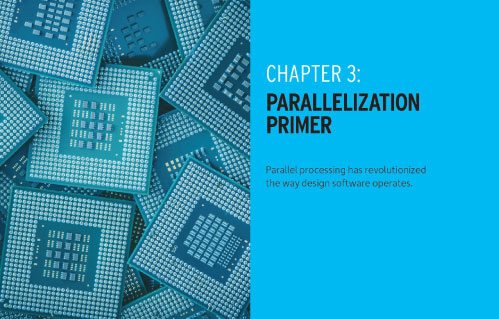 The “Parallelization Primer,” chapter 3 of “The Design Engineer’s High-Performance Computing Handbook” from DE in partnership with Intel, looks at what parallel processing means for design engineers, explains how you can get the most of out it and takes a peek at what the future of design engineering may hold.
The subsection “Where Core Count Matters” really shines. Here you’ll learn why engineering applications like rendering or CFD (computational fluid dynamics) have and will continue to advance significantly through parallelization and which applications will not go much further in the foreseeable future. For example, simulation and rendering codes are ripe to take advantage of parallelization, but mechanical simulations do not scale up for high numbers of cores nearly as well.
You'd be challenged to find a more interesting read than the “Parallelization Primer,” chapter 3 of “The Design Engineer’s High-Performance Computing Handbook.” This is the kind of stuff that fills in the gaps in your knowledge base about the tools you wield but don't really know a lot about. Hit today's Check it Out link to get your complimentary copy.
Thanks, Pal. – Lockwood
Anthony J. Lockwood Editor at Large, Desktop Engineering
Download Chapter 3 of “The Design Engineer’s High-Performance Computing Handbook” here.


Anthony J. Lockwood is Digital Engineering's founding editor. He is now retired. Contact him via [email protected].
Follow DE
Join over 90,000 engineering professionals who get fresh engineering news as soon as it is published.






About Us · Contact Us · Editorial Team · Advertising · Privacy Policy · Subscriber Services · © 2026 Digital Engineering 24/7 · Peerless Media