Helping design and engineering professionals discover, evaluate and specify technologies and processes that shorten the design cycle and enable success.


Alert!
Digital Engineering ceased publication on July 1, 2026. This website remains available as an archive of engineering content.
For inquiries or information, please email [email protected].

May 2026 Special Focus: Artificial Intelligence in Design and Simulation
In this Special Focus Issue, learn about the latest developments in the integration of artificial intelligence into engineering workflows.

April 2026 Special Focus Issue: Generative Design
In this Special Focus Issue, Digital Engineering takes a look at how generative design solutions can be used across different types of design problems and with a variety of manufacturing approaches to accelerate design space exploration, and…
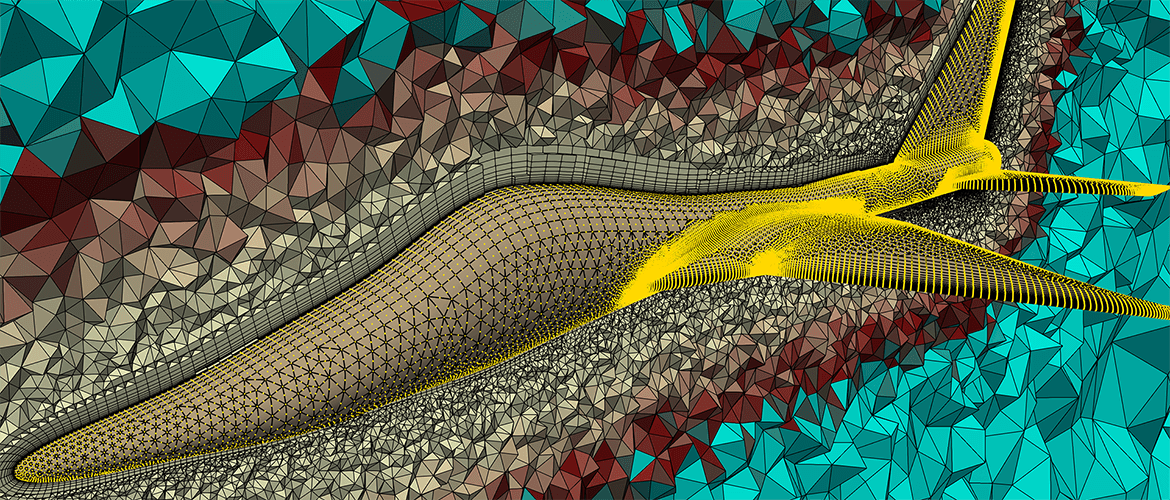
The latest release of Pointwise’s computational fluid dynamics (CFD) mesh generation software delivers high-order, curved mesh generation.
“High-order numerical schemes hold a great deal of promise for improving the accuracy of CFD with the added benefit of a decrease in the number of mesh cells versus linear mesh methods,” says John Chawner, Pointwise’s president. “Over the past several years we have been developing and testing new software to generate the high-order meshes needed by these new CFD solvers, and we are now able to release the first version of this capability.”
“Mesh curving has been a research focus at Pointwise for several years, partially funded by a NASA Phase I Small Business Innovation Research (SBIR) contract,” says Dr. Steve Karman, the Pointwise research engineer behind the new high-order capability. “Collaboration with several flow solver developers has been extremely helpful in evolving the technology to the level where realistic geometries with viscous boundary layers can now be curved. The initial release of this capability in V18.2 allows users to uniformly elevate their meshes to polynomial degree 2, 3 or 4. Under a follow-on NASA Phase II SBIR project the technology will be matured to permit mixed-order meshes and solution-based adapted meshes.”
Pointwise Version 18.2 also accelerates the generation of surface meshes (named spacing constraints, a mesh spacing synchronization command, and a quick way to split curves into pieces of equal arclength), enhances the generation of hybrid meshes with the T-Rex technique, and offers improved user experiences (an on-screen tool for panning and rotating the view, a vastly expanded context menu, and a quick display of keyboard shortcuts).
The company's Pointwise software generates structured, unstructured, overset and hybrid meshes; interfaces with CFD solvers such as ANSYS FLUENT, STAR-CCM+, OpenFOAM, and SU2 as well as many neutral formats, such as CGNS; runs on Windows, Linux, and Mac, and has a scripting language, Glyph, that can automate CFD meshing.
Sources: Press materials received from the company.

Pointwise, Inc. creates software used for grid generation and preprocessing for computational fluid dynamics (CFD). Our software product Pointwise® (and before that, our legacy product Gridgen®) is developed for and delivered to engineers…

DE's editors contribute news and new product announcements to Digital Engineering. Press releases may be sent to them via [email protected].
Follow DE
Join over 90,000 engineering professionals who get fresh engineering news as soon as it is published.






About Us · Contact Us · Editorial Team · Advertising · Privacy Policy · Subscriber Services · © 2026 Digital Engineering 24/7 · Peerless Media