Helping design and engineering professionals discover, evaluate and specify technologies and processes that shorten the design cycle and enable success.



Digital Engineering April 2026
In the latest issue of Digital Engineering, we take a look at the latest innovations in design for additive manufacturing, including the use of natural language inputs, social media cosplayers, and AI integration. The issue also includes a feature…

January Special Focus Issue: Design for Additive
In this Special Focus Issue of Digital Engineering, learn about the latest advancements in design for additive manufacturing, including new software tools, additive in automotive, custom medical devices, and more.
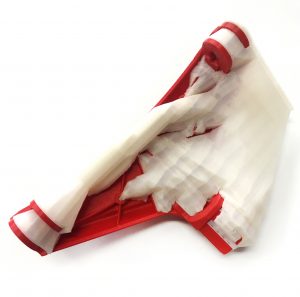 A part (in red) 3D-printed on a Stratasys fused deposition modeling (FDM) machine, with the temporary support structure (in white) still attached. Image courtesy PostProcess.
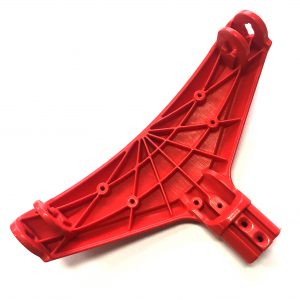 The same FDM part after supports were removed in a PostProcess automated, intelligent support-removal system. Image courtesy PostProcess.
Eight years ago, one person began a methodical journey to develop an automated, intelligent solution.
PostProcess’ founder and CEO, Daniel Hutchinson – an engineer with mechanical, electrical, computer and business degrees – wanted a better way to remove the supports from his own 3D-printed Ultem (high temperature/high strength) parts. He left his defense industry job to focus on the task, first working as a Stratasys reseller to more deeply learn the nuances of the design/print/post-process stages. Next, he worked as the engineering director for a value-added reseller, taking printers apart and discussing manufacturing challenges with every flavor of AM customer.
Finally, Hutchinson began a classic garage-based business in which he developed the hardware, software and specific chemistry for support-removal equipment and intelligent tumbling systems. By 2014, he had founded PostProcess and began offering the units that can now – just four years later – handle both plastic and metal parts from almost every AM technology.
Current “hands-off” support-removal systems involve submersing the parts in a tub of caustic solution at temperatures up to 180°F. The process can easily take 8 to 16 hours depending on part size and build material, and the PH must be constantly monitored and manually adjusted – sometimes every few hours. Depending on internal geometry, parts also end up “water logged” and need to be left to drain, adding yet more hours to the post-processing schedule.
PostProcess’ series of gentle, submersion support-removal systems, ranging from the 132-cubic-inch desktop Pico model to the 5,832-cubic-inch industrial DEMI, uses ultrasonics, proprietary agitation algorithms and eco-friendly chemistry to provide faster and more precise automatic support-removal. These algorithms control the temperature, timing and agitation frequency based on material-specific, pre-mixed detergents. Even support structures found in complex internal geometry are removed. Technician time is about one minute for loading and touch-screen set-up, and the complete unattended process takes just 1.5 to 4 hours on average.
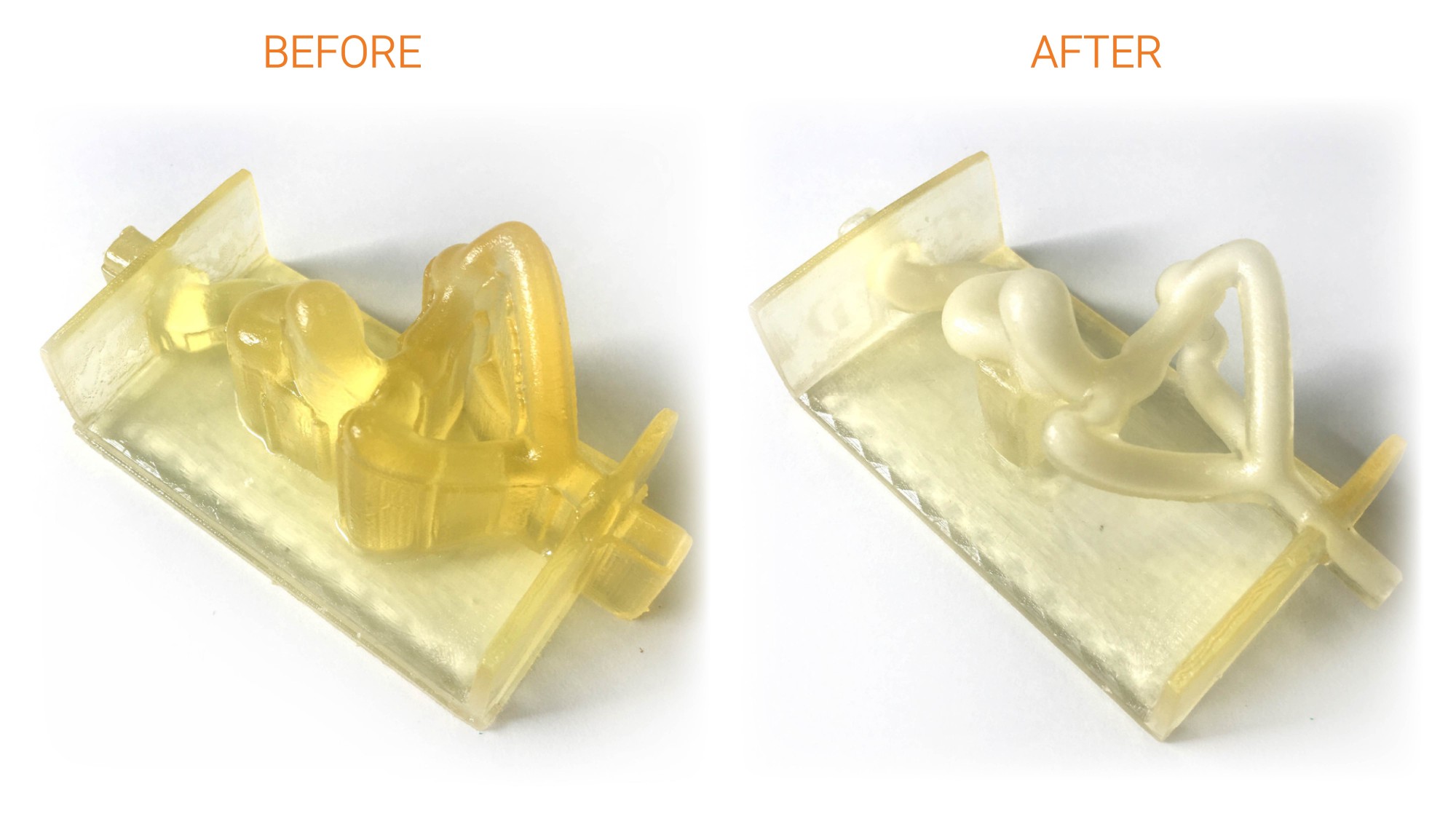
 Before and after PostProcess' automated support-removal performed on a vascular model. The part was 3D-printed in Vero build material and 706 support material on a Stratasys PolyJet system. Images courtesy PostProcess.
On the larger, industrial models (DEMI and up), the same algorithms are used in conjunction with PostProcess’ AUTOMAT3D control software. This feedback-based system continuously monitors and reacts to key process factors, controlling the energy used and supporting optional custom settings.
Addressing the needs of production-scale AM workflows, PostProcess offers the DECI and BASE models that use spray technology. In a single unit, an automated process removes the supports and rinses off the detergent, all without operator intervention. Part volume for the BASE is a generous 53 inches by 30 inches by 32 inches.
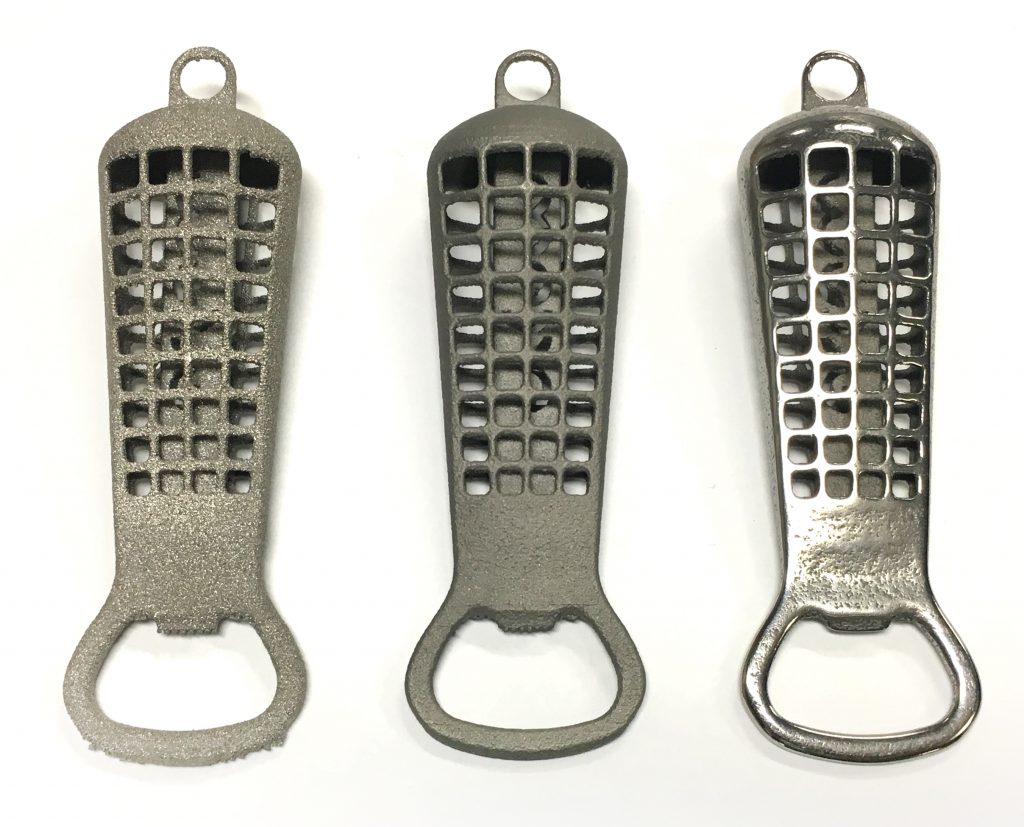 Ti64 metal parts (about 4 inches long) done with a two-step process, using the PostProcess Deci Duo for support removal and the Rador for high-shine surface finishing. Ra (roughness average) was reduced from 577 to 98, start to finish. Total process time, running batches of 30 at a time, is 4.5 hours with 5 minutes of technician attendance time for each machine. (Alternatively, the Duo could create a faster but matte finish all in one unit.) Image courtesy PostProcess.
As if these offerings aren’t impressive enough, the new DECI Duo system not only performs support removal and surface finishing in the same unit but handles both plastics and metals. Yes – in one machine. Intelligent planning software controls fluid pressure, air pressure, temperature and timing while matching the chemistry and polishing media to each material. Watch the video below to see.
In the works are efforts toward digitizing and closing the loop on “tribal knowledge,” e.g., how the build-orientation affects down-the-line surface finish. Such fine-tuned information is key to bringing AM technology into Industrie 4.0 connected solutions.


DE's editors contribute news and new product announcements to Digital Engineering. Press releases may be sent to them via [email protected].
Follow DE
Join over 90,000 engineering professionals who get fresh engineering news as soon as it is published.






About Us · Contact Us · Editorial Team · Advertising · Privacy Policy · Subscriber Services · © 2026 Digital Engineering 24/7 · Peerless Media