Helping design and engineering professionals discover, evaluate and specify technologies and processes that shorten the design cycle and enable success.


Alert!
Digital Engineering ceased publication on July 1, 2026. This website remains available as an archive of engineering content.
For inquiries or information, please email [email protected].


May 2026 Special Focus: Artificial Intelligence in Design and Simulation
In this Special Focus Issue, learn about the latest developments in the integration of artificial intelligence into engineering workflows.

April 2026 Special Focus Issue: Generative Design
In this Special Focus Issue, Digital Engineering takes a look at how generative design solutions can be used across different types of design problems and with a variety of manufacturing approaches to accelerate design space exploration, and…
 Steve Coy, president, TimeLike Systems, is set to present some of the findings from the recent ASSESS (Analysis, simulation, and systems engineering software summit) at COFES 2015, April 16-19
Everyone recognizes contemporary products are much more complex than their predecessors from just a decade ago. But the imbalance in the mechanical, electrical, and software mix suggests something else.
Steve Coy, president of TimeLike Systems, observed, “product complexity has been increasing rapidly, but their mechanical complexity remains roughly the same. The increase in complexity is largely due to integrated software and electronics.”
He estimates that, by now, the software-to-mechanical ratio in some modern products, measured in terms of the number of specific requirements, might be close to five-to-one. (Coy’s estimate is based on recent comments by Richard Riff, president, RR Executive Consulting, the person who introduced CAD/CAM at Ford Motors.)
The Chevy Volt, for example, runs on 10 million lines of code. But even that pales in comparison to the modern high-end car’s estimate 100-million-line codebase. (Codebases: Millions of Lines of Code). Market watchers and researchers estimate 90% of all innovations in the auto sector will be driven by electronics and software (“Emerging Trends in Emerging Trends in Vehicular Communications,” IEEE).
Adding software into the mix complicates those who are pursuing system modeling, a practice that continues to struggle to find the right platform. Coy said, “For a long time, auto manufacturers could build cars with just CAD and PLM. They often didn’t do system modeling, or if they did, they often did it largely in their head, based on their experience with previous similar systems. Simulation was not on the critical path, but now it is.”
Coy doesn’t think the CAD-PLM combo can adequately address the system modeling challenges, soon to be compounded by the rise of semiautonomous vehicles. “The model, in this case, is not the detailed 3D CAD model, though it is part of the overall system model,” he clarified.
Coming up with the right visual language to represent a system comprising electromechanical components and software code is not an easy task. It’s not surprising, then, that a software environment that allows such system representations to be dynamic, with links to CAD models and software code still in development, still remains elusive.
Coy reasoned, “I think you should be able to use the authoring tools you have been using (for example, your preferred CAD system) in that system modeling environment. And you should be able to swap out different elements in that system model as things change.”
The standard approach for representing such systems is to use hierarchical block diagrams, which allows you to portray the relations among system components in a hierarchical decomposition. Examples of this approach can be found in software like MathWorks’ Simulink, various tools based on the Modelica standard, and NI’s LabVIEW.
With autonomous cars, the decision-making system (that is, the software algorithm that triggers certain actions) has to be modeled and tested. Simulation and verification of such a system would include, for instance, the electro-mechanical events that would be triggered by the car’s camera view. Coy said, “visual information—rich visual data like camera views—is just another type of input or signal to be processed. You need to be able to test them out in the software-in-the-loop type of simulation.”
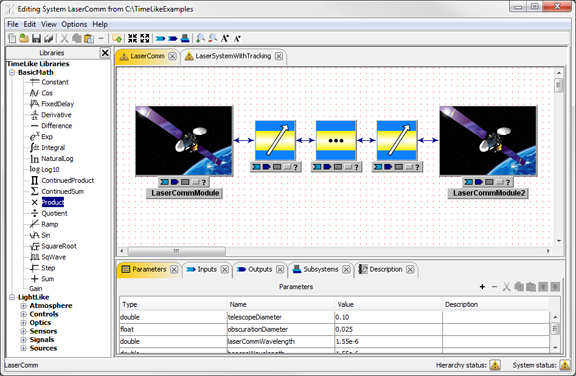 System modeling in TimeLike Systems interface.
General-purpose system modeling is the monster Coy has been wrestling with since the 90s. His product idea went through many permutations, culminating in the founding of TimeLike Systems in 2011. The firm offers what it describes as “products and services related to computer simulation of complex systems in general, and of advanced optical systems, such as high energy laser systems and compensated imaging systems, in particular.” Its products are:
Coy is one of the speakers scheduled to present the findings from The Analysis, Simulation, and Systems Engineering Software Summit (ASSESS) at the upcoming Congress on the Future of Engineering Software (COFES).


Kenneth Wong is Digital Engineering's resident blogger and senior editor. Email him at [email protected] or share your thoughts or suggestions at digitaleng.news/facebook.
Follow DE






About Us · Contact Us · Editorial Team · Advertising · Privacy Policy · Subscriber Services · © 2026 Digital Engineering 24/7 · Peerless Media