Helping design and engineering professionals discover, evaluate and specify technologies and processes that shorten the design cycle and enable success.



Digital Engineering April 2026
In the latest issue of Digital Engineering, we take a look at the latest innovations in design for additive manufacturing, including the use of natural language inputs, social media cosplayers, and AI integration. The issue also includes a feature…

January Special Focus Issue: Design for Additive
In this Special Focus Issue of Digital Engineering, learn about the latest advancements in design for additive manufacturing, including new software tools, additive in automotive, custom medical devices, and more.
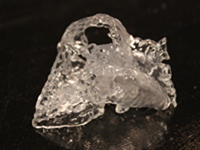 Materialise has now listed its 3D-printed cardiovascular HeartPrint models, a service provided as part of the Mimics Innovation Suite, as Class 1 medical devices in the U.S. and European Union markets. The new classification allows the company to add HeartPrint models to its pre-operative planning offerings.
"After the success of this surgery, it’s hard to imagine entering an operating room for another complex case without the aid of a 3D printed model. It’s definitely going to be standard care in the future and we’re happy to be leading the way," said Dr. Emile Bacha, a congenital heart surgeon and Director of Congenital and Pediatric Cardiac Surgery at New York-Presbyterian / Morgan Stanley Children’s Hospital.
Having a pre-procedure roadmap is invaluable. In the case of the baby in New York, there were not only holes in a heart, but the child's heart chambers were in an unusual formation.
"In the past, we had to stop the heart and look inside to decide what to do. With 3D printing technology, we are able to look at the inside of the heart in advance, giving us a road map for the surgery," Bacha said in a statement.
The success at New York-Presbyterian is not an isolated case. Last year, we wrote about efforts at Phoenix Children's Hospital to use 3D-printed heart models for surgery preparation. Earlier this year, surgeons in Barcelona used a similar model to practice a complex tumor-removal surgery several times before successfully performing the procedure on a 5-year-old boy.
Source: Materialise


Brian Albright is the editorial director of Digital Engineering.
Contact him at [email protected].

Join over 90,000 engineering professionals who get fresh engineering news as soon as it is published.






About Us · Contact Us · Editorial Team · Advertising · Privacy Policy · Subscriber Services · © 2026 Digital Engineering 24/7 · Peerless Media