Helping design and engineering professionals discover, evaluate and specify technologies and processes that shorten the design cycle and enable success.



Digital Engineering April 2026
In the latest issue of Digital Engineering, we take a look at the latest innovations in design for additive manufacturing, including the use of natural language inputs, social media cosplayers, and AI integration. The issue also includes a feature…

January Special Focus Issue: Design for Additive
In this Special Focus Issue of Digital Engineering, learn about the latest advancements in design for additive manufacturing, including new software tools, additive in automotive, custom medical devices, and more.
Face transplants, for instance, are being improved via the production of detailed 3D skull models that help surgeons plan ahead. That cuts surgery times and improves outcomes.
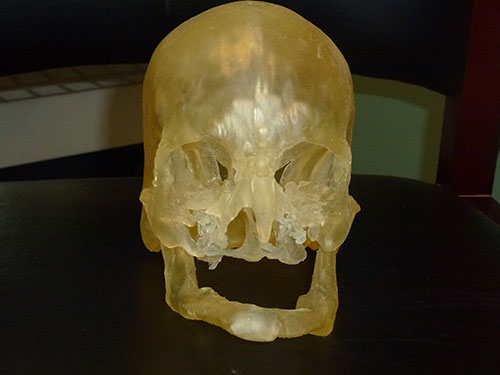 A model like this can guide surgeons during a face transplant procedure. Image: Brigham and Women's Hospital
Researchers at Brigham and Women's Hospital in Boston presented a study on 3D printing and face transplants at a meeting of the Radiological Society of North America on Dec. 1. Doctors at the hospital performed the first full transplant in the U.S. in 2011, along with four subsequent procedures.
"This is a complex surgery and its success is dependent on surgical planning," said Dr. Frank Rybicki, radiologist and director of the hospital's Applied Imaging Science Laboratory. "Our study demonstrated that if you use this model and hold the skull in your hand, there is no better way to plan the procedure."
Face transplant patients often have multiple surgeries that result in plates, screws, bone grafts, and other modifications to their faces prior to the transplant. A 3D printed model helps surgeons map out where these modifications are.
Each transplant recipient undergoes a CT scan to build a life-size skull model, which is segmented and processed using customized software. Brigham and Women's uses Stratasys Objet500 Connex3 and Objet Eden 260VS 3D printers.
"If there are absent or missing bony structures needed for reconstruction, we can make modifications based on the 3-D printed model prior to the actual transplantation, instead of taking the time to do alterations during ischemia time," Dr. Rybicki said. "The 3-D model is important for making the transplant cosmetically appealing."
According to the researchers, 3D printing also helps when cutting bone grafts for the face from the ribs or femur. Printed models help guide the complex cutting, so the grafts fit better.
Source: LiveScience


Brian Albright is the editorial director of Digital Engineering.
Contact him at [email protected].

Join over 90,000 engineering professionals who get fresh engineering news as soon as it is published.






About Us · Contact Us · Editorial Team · Advertising · Privacy Policy · Subscriber Services · © 2026 Digital Engineering 24/7 · Peerless Media