Helping design and engineering professionals discover, evaluate and specify technologies and processes that shorten the design cycle and enable success.



Digital Engineering April 2026
In the latest issue of Digital Engineering, we take a look at the latest innovations in design for additive manufacturing, including the use of natural language inputs, social media cosplayers, and AI integration. The issue also includes a feature…

January Special Focus Issue: Design for Additive
In this Special Focus Issue of Digital Engineering, learn about the latest advancements in design for additive manufacturing, including new software tools, additive in automotive, custom medical devices, and more.
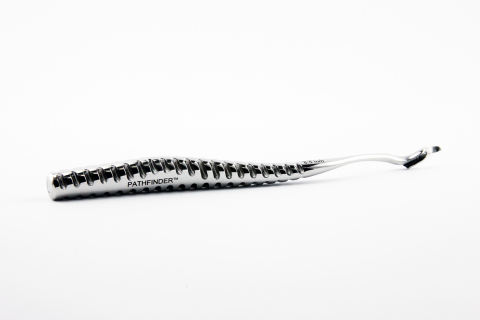
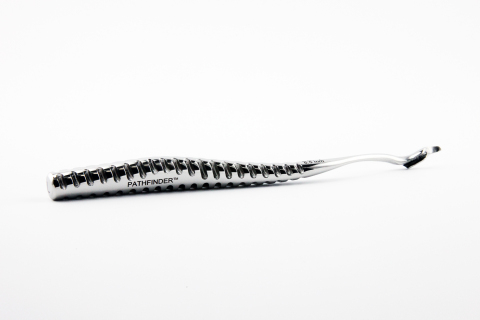
Stratasys is printing DanaMed’s Pathfinder ACL Guide out of biocompatible Inconel 718 material using direct metal laser sintering (DMLS) technology, providing what the company says is a 97% cost savings over conventional manufacturing methods.
The ACL connects the tibia to the femur, and roughly 200,000 people in the U.S. fully or partially tear it each year. Many of them re-injure themselves even after repair. That’s because the common surgery involves re-attaching the ligament to the wrong spot on the femur.
The Pathfinder works in conjunction with a flexible drill to guide the drill to the normal attachment point on the femur. The tool is shaped to match the anatomy of the knee.
Dr. Dana Piasecki, an orthopedic surgeon at OrthoCarolina Sports Medicine, in Charlotte, NC, developed the tool after experimenting with surgical techniques that would improve the graft positioning.
Finding a way to economically manufacture the complex tool in small quantities was a challenge that Piasecki says only 3D printing could meet. To commercialize the tool, DanaMed sought out a process to affordably and efficiently manufacture the instrument while providing the flexibility to make changes on the fly.
Piasecki initially hand-carved concepts, then turned to Laser Design to print prototypes using Fused Deposition Modeling. Laser Design recommended Stratasys Direct’s DMLS equipment for production parts.
“Being able to make design changes and 3D print new tools within days was extremely important to helping us perfect the design. We could get feedback from a doctor, make design adjustments and send an updated Pathfinder within a week – something we wouldn’t be able to do with investment casting or injection molding,” said Jim Duncan, CEO of DanaMed.
The company claims the tool has achieved a 95% success rate in anchoring grafts in native ACL locations. Anchoring grafts in this way allows repaired ACLs to handle the same stress as a natural ACL once could.
DanaMed expects it will take two to three years to see results from the initial procedures. The company will continue to use DMLS to manufacture the tools.
Source: Stratasys


Brian Albright is the editorial director of Digital Engineering.
Contact him at [email protected].

Join over 90,000 engineering professionals who get fresh engineering news as soon as it is published.






About Us · Contact Us · Editorial Team · Advertising · Privacy Policy · Subscriber Services · © 2026 Digital Engineering 24/7 · Peerless Media