Helping design and engineering professionals discover, evaluate and specify technologies and processes that shorten the design cycle and enable success.


Alert!
Digital Engineering ceased publication on July 1, 2026. This website remains available as an archive of engineering content.
For inquiries or information, please email [email protected].

Digital Engineering April 2026
In the latest issue of Digital Engineering, we take a look at the latest innovations in design for additive manufacturing, including the use of natural language inputs, social media cosplayers, and AI integration. The issue also includes a feature…

January Special Focus Issue: Design for Additive
In this Special Focus Issue of Digital Engineering, learn about the latest advancements in design for additive manufacturing, including new software tools, additive in automotive, custom medical devices, and more.
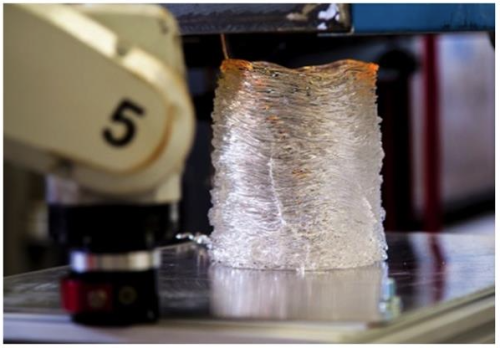
Creating glass art takes a lot of heat; glass blowing furnaces run at about 2000°F. While the new process won't put any glass blowers out of business, it does offer a new way to create with glass in a more automated fashion.
RISD's Stefanie Pender and Virginia Tech architecture professor Nathan King have been working together since 2013 via the Glass Robotics Lab to create robotically actuated molds, 3D printing solutions, and other fabrication processes.
The six-axis glass printing process was first developed in 2013. While the process has continued to improve, most of the printed objects are fairly rough looking because the glass cools unevenly.
“This research is an example of innovation that can occur at the intersection of art, design, technology, and science,” said Pender, a glass artist at RISD. “Instead of a technology-driven approach, we can approach digital fabrication from a place of profound material understanding. This research is evidence that the traditional technical arts will not be replaced by digital fabrication, instead, the technical arts will help to drive and support the direction of future making.”
Researchers at MIT's Mediated Matter Group also created a 3D glass printing process that coils molten glass strands on top of one another. The optically transparent glass printing process, called G3DP, and operates at 1900°F.
Source: Tech Crunch


Brian Albright is the editorial director of Digital Engineering.
Contact him at [email protected].






About Us · Contact Us · Editorial Team · Advertising · Privacy Policy · Subscriber Services · © 2026 Digital Engineering 24/7 · Peerless Media