Helping design and engineering professionals discover, evaluate and specify technologies and processes that shorten the design cycle and enable success.


Alert!
Digital Engineering ceased publication on July 1, 2026. This website remains available as an archive of engineering content.
For inquiries or information, please email [email protected].

Digital Engineering April 2026
In the latest issue of Digital Engineering, we take a look at the latest innovations in design for additive manufacturing, including the use of natural language inputs, social media cosplayers, and AI integration. The issue also includes a feature…

January Special Focus Issue: Design for Additive
In this Special Focus Issue of Digital Engineering, learn about the latest advancements in design for additive manufacturing, including new software tools, additive in automotive, custom medical devices, and more.
Funded by ASI—the Italian Space Agency, the two-year GLAMS Project (Geopolymers for Additive Manufacturing and Lunar Monitoring) aims to create structural elements for the construction of lunar bases through a 3D printing approach that uses cement binders extracted from lunar soils (regolith).
By exploiting locally available raw materials, the concept of the project is to minimize the costs and environmental impact due to the transport of raw materials from Earth to the Moon.
Coordinated by the Center for Space Studies and Activities "Giuseppe Colombo" (CISAS) of the University of Padua, the GLAMS Project holds a partnership with the Institute of Condensed Matter Chemistry and Energy Technologies of the CNR (ICMATE) based in Genoa andWASP, the Italian leader of 3D printing. The project includes Professor Luca Valentini of the Department of Geosciences as scientific manager and Prof Carlo Bettanini and Dr. Giorgia Franchin of the Department of Industrial Engineering who will lead specific work packages.
The research team intends to optimize the lunar cement formulated from regolith soils found on the Moon. The base must consider environmental conditions, including high temperature ranges, reduced gravity, atmospheric pressure, and possible impact of micrometeorites.
During the first phase of the project, Luca Valentini and Giorgia Franchin guided the research unit of the University of Padua for the formulation of the "geo polymer binders" obtained from the chemical activation of lunar regolith. From here, the Institute of Condensed Matter Chemistry and Energy Technologies of the CNR of Genoa selected suitable foaming agents that ensure a macro-porous structure affixed to the hardened geopolymeric binder.
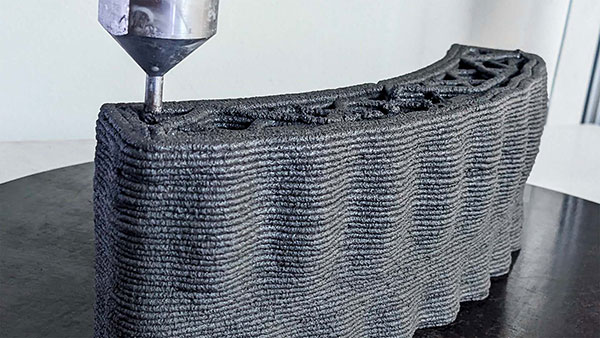
Subsequently, WASP implemented the formulations undertaken during the previous phases of the project, to create a prototype of the structural element of a medium-scale macro-porous structure fabricated through 3D printing. Finally, a group coordinated by Carlo Bettanini will provide sensors for the structural elements, integrating appropriate sensor networks, aimed at the continuous monitoring of micro-meteoritic impacts.
The hope is that the GLAMS Project will help meet the needs of space agencies by creating semi-permanent human settlements on the moon within the next decade.
The project was presented at the 75th International Astronautical Congress (IAC) in Milano, as one of the projects of the IAF Space Exploration Symposium, for the Session: Moon Exploration. During the event, the research team presented the project and showcased one of the first 3D-printed geopolymer samples, produced using the WASP 40100 LDM equipped with the Manual Feeding System Extruder.
There was a presentation of GLAMS Project on Italian National TV.
Sources: Press materials received from the company and additional information gleaned from the company’s website.


DE's editors contribute news and new product announcements to Digital Engineering. Press releases may be sent to them via [email protected].
Follow DE
Join over 90,000 engineering professionals who get fresh engineering news as soon as it is published.






About Us · Contact Us · Editorial Team · Advertising · Privacy Policy · Subscriber Services · © 2026 Digital Engineering 24/7 · Peerless Media