Helping design and engineering professionals discover, evaluate and specify technologies and processes that shorten the design cycle and enable success.


Alert!
Digital Engineering ceased publication on July 1, 2026. This website remains available as an archive of engineering content.
For inquiries or information, please email [email protected].


Digital Engineering April 2026
In the latest issue of Digital Engineering, we take a look at the latest innovations in design for additive manufacturing, including the use of natural language inputs, social media cosplayers, and AI integration. The issue also includes a feature…

January Special Focus Issue: Design for Additive
In this Special Focus Issue of Digital Engineering, learn about the latest advancements in design for additive manufacturing, including new software tools, additive in automotive, custom medical devices, and more.
We’ll start this Roundup with news about Objet expanding its market into Japan. The company has established Objet Japan KK with the assistance of Fasotec Co. Ltd, Objet’s distributor for the region. This move is meant to offer local support for Japanese business relations.
“Japan is a very special market in which innovative technology, advanced applications and new materials are in high demand,” said Gilad Yron, managing director of Objet AP. “Objet has invested significantly in R&D responding to these demands and we feel that the establishment of local presence will put us in a better position to offer the most appropriate solutions and support suited to the Japanese market.”
Next up, the Fraunhofer Institute for Laser Technology ILT has developed a method which allows for quality testing of nozzles used in laser sintering. While in use, the nozzle used to deliver powdered material into the melt can become worn, resulting in inaccuracies in the powder deposition.
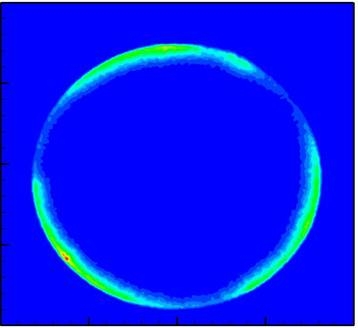
The process developed by Fraunhofer uses a laser beam to illuminate the powder gas flow and a high-speed camera to capture photos of exactly where the stream is going.
From the press release:
Thanks to the camera's high frame rate, it is possible to precisely determine the number and position of individual powder particles at a defined point in time. Based on similar principles to laser caustic measurement, the lateral laser beam moves down the powder gas stream layer by layer, requiring just a few seconds to capture the data for each layer. The system then calculates the particle density distribution for each layer from the several thousand individual images captured by the camera. Finally, the individual layer images are superimposed on each other to yield the overall spatial particle density distribution.

Moving from quality testing to end-use, Festo has created what it calls the ExoHand using 3D scanning and 3D printing. The ExoHand is a robotic glove that enhances the user’s strength. Each ExoHand is tailored to its user by making a 3D scan of the hand. Parts are created using selective laser sintering. This is the sort of customization that would be massively more expensive using subtractive manufacturing methods.
Finally, Rapid Ready takes you to the movies. Even if you have no interest in ParaNorman, you might have kids that make your interest irrelevant. As a nerd, I find the idea for the movie amusing, but if you aren’t much of a zombie fan, you can watch and maybe take some pleasure in the knowledge that 3D printing is responsible for a fair chunk of what you’re seeing.
Using four ZPrinter 650 systems, the creators made more than 31,000 different facial parts, which amounts to about 8,000 different faces and 1.5 million possible expressions. That’s a 1.49 million facial expression improvement over a certain actress in a certain vampire movie series. Other films to use 3D printing include Coraline and Iron Man.
Below you’ll find a video demonstrating Festo’s ExoHand.
Sources: Objet, Fraunhofer Institute, Design News, Collider


John Newman is a Digital Engineering contributor who focuses on 3D printing. Contact him via [email protected] and read his posts on Rapid Ready Technology.
Follow DE






About Us · Contact Us · Editorial Team · Advertising · Privacy Policy · Subscriber Services · © 2026 Digital Engineering 24/7 · Peerless Media