Helping design and engineering professionals discover, evaluate and specify technologies and processes that shorten the design cycle and enable success.


Alert!
Digital Engineering ceased publication on July 1, 2026. This website remains available as an archive of engineering content.
For inquiries or information, please email [email protected].

Design & Simulation Software Guide 2025
In this Special Issue, Digital Engineering presents its second annual guide to design and simulation software vendors.

Design & Simulation Software Guide
In this Special Issue, Digital Engineering presents its inaugural guide to design and simulation software vendors, including listings for CAD, CAM, simulation, generative design, PLM, rendering and visualization, design for additive manufacturing,…
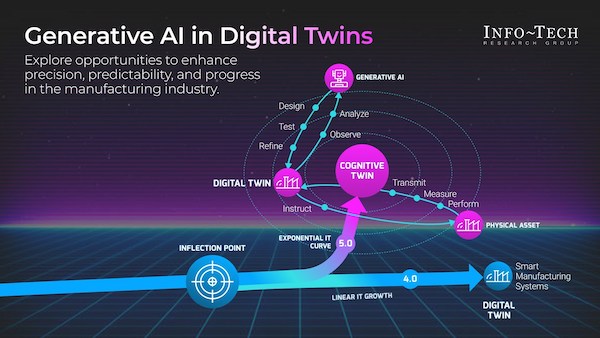
Info-Tech Research Group has released a new resource report that outlines strategies for manufacturers to leverage generative artifical intelligence (Gen AI) and digital twins to enhance precision, predictability, and progress in manufacturing.
"Digital twins have long been recognized for their potential to revolutionize predictive maintenance and streamline processes. When combined with Gen AI, the possibilities for the manufacturing industry expand exponentially," says Shreyas Shukla, principal research director at Info-Tech Research Group. "However, many manufacturers worldwide continue to grapple with the challenges of Industry 4.0 and the remnants of pandemic-era supply chain disruptions. The fusion of Gen AI and digital twins promises not only to optimize current manufacturing processes but also to usher in a new era of design, simulation, and real-time predictive analysis."
Info-Tech's research identifies several obstacles facing the manufacturing sector, including the significant compatibility of integrating new technologies with existing systems. According to the report, there is a lack of skilled professionals who are well-versed in both the manufacturing industry and advanced technologies, including AI. Moreover, there is a need for a comprehensive understanding and ethical use of Gen AI to ensure integrity in decision-making processes within manufacturing operations.
According to Info-Tech's research, cognitive twins play an important role in the modern adaptive cognitive manufacturing system (ACMS) paradigm. ACMS is different from other modern manufacturing paradigms, such as Industry 4.0, and is primarily focused on intelligent collaboration between humans, IT, and OT.
The firm's blueprint names some of the strategic advantages of harnessing exponential IT technologies like Gen AI and digital twins across the manufacturing industry. Those advantages are:
In the blueprint, Info-Tech underscores the significant role AI is expected to play in manufacturing over the next decade, potentially outpacing the impact of automation in the past. The firm suggests that organizations prioritizing AI investments now can significantly expand their offerings and capabilities, leading to increased market presence, revenue growth, and improved customer satisfaction.
Sources: Press materials received from the company and additional information gleaned from the company’s website.


Brian Albright is the editorial director of Digital Engineering.
Contact him at [email protected].






About Us · Contact Us · Editorial Team · Advertising · Privacy Policy · Subscriber Services · © 2026 Digital Engineering 24/7 · Peerless Media