Helping design and engineering professionals discover, evaluate and specify technologies and processes that shorten the design cycle and enable success.



Digital Engineering April 2026
In the latest issue of Digital Engineering, we take a look at the latest innovations in design for additive manufacturing, including the use of natural language inputs, social media cosplayers, and AI integration. The issue also includes a feature…

January Special Focus Issue: Design for Additive
In this Special Focus Issue of Digital Engineering, learn about the latest advancements in design for additive manufacturing, including new software tools, additive in automotive, custom medical devices, and more.
Researchers at ETH Zurich’s Functional Materials Laboratory and the Product Development Group Zurich have printed a silicon artificial heart that beats almost like the real thing. They hope to perfect the device so that it can be used as a blood pump for patients who are waiting for a heart transplant.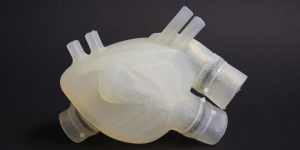
“[O]ur goal is to develop an artificial heart that is roughly the same size as the patient’s own one and which imitates the human heart as closely as possible in form and function,” said Nicholas Cohrs, a doctoral student in the research group.
The flexible heart was printed using a lost-wax casting technique. It includes a right and left ventricle, and operates using pressurized air to pump fluid from the chambers. The goal is to create an artificial heart that operates as closely to a real heart as possible, which is why printing a model that is the same size and shape as a human heart was an important component of the project.
The Product Development Group Zurich has developed a testing environment to simulate the human cardiovascular system. The two organizations also collaborated on the Zurich Heart Project through the University of Medicine Zurich.
According to the team, the current model can only last for roughly 3,000 beats (or around half an hour) before the material fails. It is described as a "silicone mono block with complex inner structure," and weights 390 grams.
The research was published in the journal Artificial Organs. You can see the heart in action in the video below.
Source: ETH Zurich


Brian Albright is the editorial director of Digital Engineering.
Contact him at [email protected].

Join over 90,000 engineering professionals who get fresh engineering news as soon as it is published.






About Us · Contact Us · Editorial Team · Advertising · Privacy Policy · Subscriber Services · © 2026 Digital Engineering 24/7 · Peerless Media