Helping design and engineering professionals discover, evaluate and specify technologies and processes that shorten the design cycle and enable success.


Alert!
Digital Engineering ceased publication on July 1, 2026. This website remains available as an archive of engineering content.
For inquiries or information, please email [email protected].

Digital Engineering April 2026
In the latest issue of Digital Engineering, we take a look at the latest innovations in design for additive manufacturing, including the use of natural language inputs, social media cosplayers, and AI integration. The issue also includes a feature…

January Special Focus Issue: Design for Additive
In this Special Focus Issue of Digital Engineering, learn about the latest advancements in design for additive manufacturing, including new software tools, additive in automotive, custom medical devices, and more.
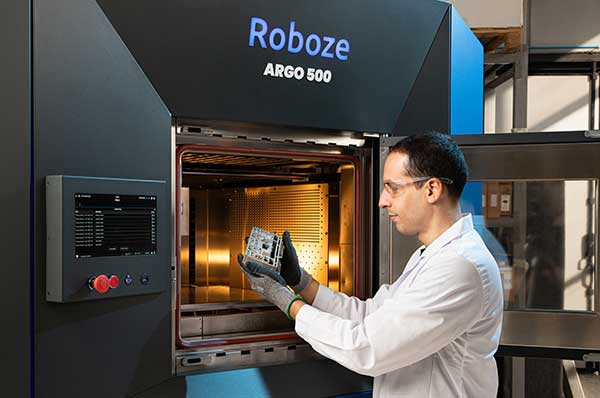
Roboze, a manufacturer of industrial 3D printing technology for extreme end-use applications, unveils its U.S. headquarters in Houston, TX, with plans to hire more than 100 employees in the coming 24 months to re-shore domestic production, streamline warehousing costs and mitigate supply chain challenges. The facility will enable Roboze to expand its engineering and production capabilities in the U.S. to meet high industrial demand from the aerospace, oil and gas, energy, manufacturing and mobility sectors.
Roboze has developed a 3D printing offering that couples high-performance polymer components with point-of-use 3D printing. Capable of replacing metals in extreme applications, Roboze provides manufacturers with the ability to print parts for high chemical and high-strength applications on-site.
To address supply chain challenges, Roboze enables small to medium enterprises to bring production back to the point of use. Roboze customers including GE, Leonardo and the U.S. Army use Roboze's on-demand and on-site production to reduce lead time and save on costs. With precise results from its beltless technology, Roboze creates an opportunity to decentralize additive manufacturing to address production gaps in the current global supply chain while simultaneously reducing transportation contributions to greenhouse gas emissions.
Founded in Italy, Roboze is the latest in a long string of tech companies relocating to Texas for proximity to key industries such as aerospace and energy in addition to renowned universities in Houston. Roboze plans to hire 30 new employees in the next 90 days to build out its engineering, marketing and sales teams in the U.S. to further develop a range of products. By the end of the year, the company plans to grow by 70% with the majority of new team members originating from the Houston area.
"Houston ranks as one of the top U.S. cities for manufacturing plants and industrial employment and home to exciting scientific initiatives at the Houston Spaceport and Rice University," says Roboze founder and CEO Alessio Lorusso. "We are delighted to open up new headquarters in Houston and bolster our team with the best and brightest engineers and technical workers in Houston to position the city as one of the most important 3D printing hubs globally."
Sources: Press materials received from the company and additional information gleaned from the company’s website.


DE's editors contribute news and new product announcements to Digital Engineering. Press releases may be sent to them via [email protected].
Follow DE






About Us · Contact Us · Editorial Team · Advertising · Privacy Policy · Subscriber Services · © 2026 Digital Engineering 24/7 · Peerless Media