Helping design and engineering professionals discover, evaluate and specify technologies and processes that shorten the design cycle and enable success.



Digital Engineering April 2026
In the latest issue of Digital Engineering, we take a look at the latest innovations in design for additive manufacturing, including the use of natural language inputs, social media cosplayers, and AI integration. The issue also includes a feature…

January Special Focus Issue: Design for Additive
In this Special Focus Issue of Digital Engineering, learn about the latest advancements in design for additive manufacturing, including new software tools, additive in automotive, custom medical devices, and more.
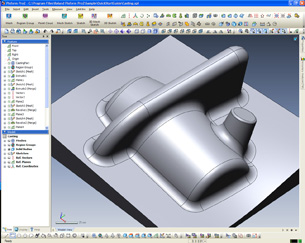 |
Roland DGA Corporation has released the new Pixform Pro II reverse engineering software for its LPX DS series of 3D laser scanners.
Designed for reverse engineering, Roland LPX DS scanners capture complex data for a variety of CAD and computer graphics applications, including hand-held consumer products design, package design, hand-sculpted items, and biomedical product design. The new Pixform Pro II reverse engineering software optimizes the capabilities of the LPX DS series by enabling professionals to quickly and intuitively convert scan data into fully editable 3D CAD models.
“Pixform Pro II is a great addition to the LPX DS series as it can quickly and easily transform scan data into high-resolution parametric 3D CAD data,” says Rick Scrimger, vice president and general manager for Roland. “LPX DS users can now generate and edit CAD models from existing parts or partial models, a process that can dramatically lower product development costs and reduce time to market.”
Roland’s Pixform Pro II software allows users to go from LPX DS scan data to a parametric CAD model without a great deal of training. Featuring built-in wizards, assistants and analyzers, Pixform Pro II enables users to create quality usable data in just a few minutes. The liveTransfer feature enables users to transfer their completed files directly to popular software packages, including SolidWorks, UGS NX and Pro/Engineer Wildfire. There is no need to save files and then import them into the design software.
Pixform Pro II reverse engineering software is priced at $5,995. LPX DS series scanners are priced at $8,395 for the LPX-60, $12,595 for the larger LPX-600, and $15,995 for the high precision LPX-1200. Leasing options are available.
For more information, visit the Roland Web site.
Sources: Press materials received from the company and additional information gleaned from the company’s website.


DE's editors contribute news and new product announcements to Digital Engineering. Press releases may be sent to them via [email protected].
Follow DE
Join over 90,000 engineering professionals who get fresh engineering news as soon as it is published.






About Us · Contact Us · Editorial Team · Advertising · Privacy Policy · Subscriber Services · © 2026 Digital Engineering 24/7 · Peerless Media